Ditch Spreadsheets: Data First Sports Memorabilia Reselling for FBA

Ditch Spreadsheets: Data First Sports Memorabilia Reselling for FBA
For pro resellers, the fastest way to scale sports memorabilia flips is a repeatable loop: validate the brand or distributor, run true landed-cost math, place a small test PO, and route verified inventory into FBA. Skip a step and margin errors compound fast. This five part routine, supplier check, landed cost, test order, compliance confirmation, then repeat, turns a hobby-grade side hustle into an operation you can actually forecast, and a terminal built for the job beats a spreadsheet every time you need the numbers fast.
TL;DR:
- Verifying supplier legitimacy involves confirming their presence on authorized distributor pages, a physical address, a business email, and clear communication on MOQ, lead time, and invoice format.
- Accurate landed-cost calculations must include unit price, packaging, labeling, freight, duties, inbound shipping, fees, and a buffer for returns to determine true profitability.
- Effective inventory timing requires sending stock 60 to 90 days before peak demand, testing micro-niches with low MOQs, and avoiding late shipments that underperform against established, reviewed listings.
- Ensuring invoices meet Amazon standards with supplier details, itemized lists, recent dates, and matching buyer info is crucial to avoid rejection delays, especially when applying for gated categories.
- Diversifying sales channels across Amazon, eBay, Mercari, Poshmark, and niche platforms protects margins and speeds up sales, emphasizing the importance of speed and trust signals in buyer engagement.
Looking for a tool to run the numbers? ResellReady's reseller profit calculator pulls live comps across eBay, Depop, Mercari, and Poshmark and calculates true net profit after fees. Compare plans and pricing — Basic starts with a 3-day free trial.
Table of Contents
- Quick Gating Checklist to Filter Bad Supplier Leads Fast
- Sourcing Tactics: Where to Find Authorized Distributors
- Pricing and Landed-Cost Math That Doesn’t Lie to You
- Amazon Listing, Ungating, and Documentation That Won’t Get Rejected
- Seasonality and Timing for Sports Inventory
- Authenticity and Payment Safety Before You Wire Money
- The Operational Loop: Price List to PO to Replenishment
- Handling Returns, Customer Service, and Dispute Resolution
- Tracking and Analyzing Sales Performance and Profitability Metrics
- Marketing and Customer Engagement Strategies to Boost Sales
- Legal Considerations and Regulations Specific to This Category
- Best Platforms Beyond Amazon for Sports Inventory
- Author Perspective: Verified Suppliers and Landed-Cost Discipline Win
- Resell Ready: The Operational Toolkit to Run This Playbook
- Sources
- FAQ
Quick Gating Checklist to Filter Bad Supplier Leads Fast
Most wasted sourcing hours go toward suppliers who were never going to work out. A five minute gate before you request pricing saves you from chasing dead ends.
Before you send a single email, confirm these basics:
- The supplier appears on the brand’s own authorized distributor page, or can produce a distributor listing you can verify independently
- A real physical address, a business email domain (not a free Gmail account), and a working phone line
- Clear answers on MOQ, sample policy, lead time, and whether their invoices meet Amazon’s format requirements
- No red flags like WhatsApp-only communication, an unverifiable business registration number, or invoices missing line-item detail
Pro Tip: Ask for a sample invoice before you ask for a price list. A supplier who hesitates to show you invoice formatting is telling you something about how they’ll handle documentation later, when you actually need it for ungating.
Sourcing Tactics: Where to Find Authorized Distributors
Legitimate sports memorabilia wholesale supply doesn’t usually come from a cold Alibaba search. It comes from working backward from the brand itself, then widening out.
- Start at the source. Most equipment and licensed-gear brands publish a distributor locator or a wholesale contact page. That’s your first stop, and it’s also your best evidence trail for Amazon later.
- Use targeted search operators. Pairing a brand name with phrases like “authorized distributor” or “wholesale account” in quotes narrows results fast. Google Maps searches for regional wholesalers turn up smaller distributors who don’t rank well organically but still carry authentic stock.
- Work trade shows and industry networks. In-person contacts at sporting goods trade events tend to convert into higher-trust relationships than cold outreach, and they often unlock pricing tiers not listed publicly.
- Ask for the right documents on first contact. Request a price list, sample availability, and confirmation that invoices include supplier details, itemized SKUs, and dates, the exact fields Amazon’s wholesaler sourcing guidance says it checks during approval.
Sites like Catalist maintain catalogs of sports equipment suppliers that already issue Amazon-compliant invoices, which is worth checking before you spend a week vetting an unknown distributor from scratch.
Pricing and Landed-Cost Math That Doesn’t Lie to You
A price list quote is not your cost. Your real number, the one that decides whether you buy, includes every line item between the factory and a live FBA listing.
Run the full stack every time:
- Unit cost and packaging
- Labeling and factory prep (especially FBA-compliant labeling)
- Freight, duties, and customs clearance
- Inbound shipping to the FBA warehouse
- Platform fees: pick, pack, storage, and referral commissions
- A returns provisioning buffer
Buyers in 2026 increasingly demand audited landed-cost quotes rather than trusting a factory’s EXW number, according to sourcing trend data from SKDK Sport’s buyer pulse, which also notes that flexible MOQ tiers of 100 to 300 units have become standard for buyers testing new SKUs.
The most common way sellers blow their margin math is matching the wrong ASIN, mixing up case-pack pricing with per-unit pricing, or forgetting a fee line. Set a hard margin floor; if a SKU doesn’t clear it after all cost lines are accounted for, it doesn’t get a PO regardless of how good the top-line price appears.
Amazon Listing, Ungating, and Documentation That Won’t Get Rejected
Invoice rejection is the single most avoidable delay in this business, and it’s almost always a formatting problem, not a legitimacy problem.
- Check every invoice field before you submit it. Amazon wants supplier information, an itemized product list, a date within the last 180 days, and buyer information that matches your seller account exactly. Minimum-unit purchase evidence may be required for some categories.
- Use “Apply to Sell” in Seller Central for any brand or category that’s gated. This is where your invoice quality either clears you in a day or bounces you into a review loop.
- Decide bulk versus single-listing workflows early. Bulk listing saves time on large catalogs, but attaching supporting documents per ASIN gets messier at scale, plan your file structure before you start uploading.
- Keep records past the point of approval. Amazon audits sellers after the fact, and a supplier who goes dark six months later shouldn’t leave you scrambling for proof of authenticity.
Seasonality and Timing for Sports Inventory
Sports memorabilia and licensed gear ride real seasonal waves, playoff runs, draft season, back-to-school sports signups, and timing your inbound shipments against those waves is half the battle.
- Get seasonal inventory into FBA 60 to 90 days ahead of the peak window; Amazon’s own seasonal timing guidance ties this window directly to ranking and review momentum before demand spikes
- Diversify your product cadence across a few sports or leagues so cash isn’t tied up waiting on one narrow peak
- Use lower MOQ tiers, 100 to 300 units, to test micro-niches before committing to a full container
- Before reordering, check brand health, current fee structure, real ROI on the last cycle, and whether you still hold the buy box
Inventory that lands less than 60 days before peak demand usually underperforms established listings that already have reviews and ranking history, so late shipments often mean selling into a cold listing at the worst possible time.
Authenticity and Payment Safety Before You Wire Money
Counterfeit risk in licensed sports gear is real, and it’s the kind of mistake that costs you both the inventory and the Amazon account standing you built.
- Verify the supplier’s business license and, where the category requires it, a brand authorization letter
- Request physical samples and, when the supplier can provide it, batch-level traceability
- Document the full chain of custody: invoices, bills of lading, and photos of labels, tags, and serial numbers
- Have your prep center flag mislabeling issues before FBA inbound, not after a customer complaint triggers a suspension
Pro Tip: Never wire a large payment based on photos alone. Resell-ready’s own breakdown of four checks before you wire covers the exact verification sequence, and the same discipline applies whether you’re sourcing footwear or licensed sports gear.
The Operational Loop: Price List to PO to Replenishment
Once sourcing and compliance are solid, the real leverage comes from turning this into a repeatable cadence instead of a one-off scramble.
- Filter every price list the same way. Check seller count on the ASIN, buy box presence, whether every fee line is accounted for, and whether the ROI math clears your floor after landed cost.
- Size a test PO deliberately. Route it via DDP or through a prep center depending on your landed-cost profile, and keep the first order small enough that a bad batch doesn’t sink the quarter.
- Sync shipment and inventory data as it moves. Capital exposure and gross versus net profit need to update in real time, not at month-end when it’s too late to adjust.
- Decide replenishment on data, not habit. A SKU that sold well last cycle isn’t automatically worth reordering if fees crept up or a competitor took the buy box.
This is the exact loop Resell-ready’s terminal is built to run: paste an ASIN, get instant ROI and margin data, and check the verified supplier database instead of rebuilding the same filter logic in a spreadsheet every week.
Handling Returns, Customer Service, and Dispute Resolution
Return rates on sports memorabilia and licensed gear tend to run higher than average consumer goods because condition expectations are subjective, a jersey that looks “game-worn quality” to one buyer looks disappointing to another.
Build a return policy into your cost math from day one, not as an afterthought. That means the returns provisioning buffer mentioned earlier in your landed-cost calculation isn’t optional padding, it’s a real line item that protects your margin floor when a percentage of units inevitably come back.
For FBA sellers, most return handling runs through Amazon’s own process, but disputes get messier when a buyer claims an item is inauthentic or materially different from the listing. Keep your documentation trail, invoices, supplier authorization letters, batch photos, ready to submit if a dispute escalates to an A-to-z claim. A seller with a clean paper trail resolves these in days; a seller without one can lose the claim by default.
Selling across multiple channels means juggling different dispute systems entirely, eBay’s Money Back Guarantee works differently from Amazon’s claims process, and Mercari or Poshmark disputes often come down to direct messaging with the buyer before a platform even gets involved. Route your customer service responses fast. Slow replies on authenticity questions are what push a buyer from “let me ask” straight to “let me dispute.”
Tracking and Analyzing Sales Performance and Profitability Metrics
The metric that matters most isn’t revenue, it’s net profit per ASIN after every fee, return, and landed-cost line is subtracted. Sellers who track only top-line sales routinely miss SKUs that are quietly losing money on paper while looking like winners in a sales dashboard.
Three numbers deserve a weekly check: gross margin by SKU, capital currently tied up in unsold inventory, and sell-through rate against your 60 to 90 day seasonal window. A SKU with a healthy margin but a six-month sell-through timeline is tying up cash you need for the next seasonal cycle, and that’s a cost most spreadsheets don’t surface until it’s already a problem.
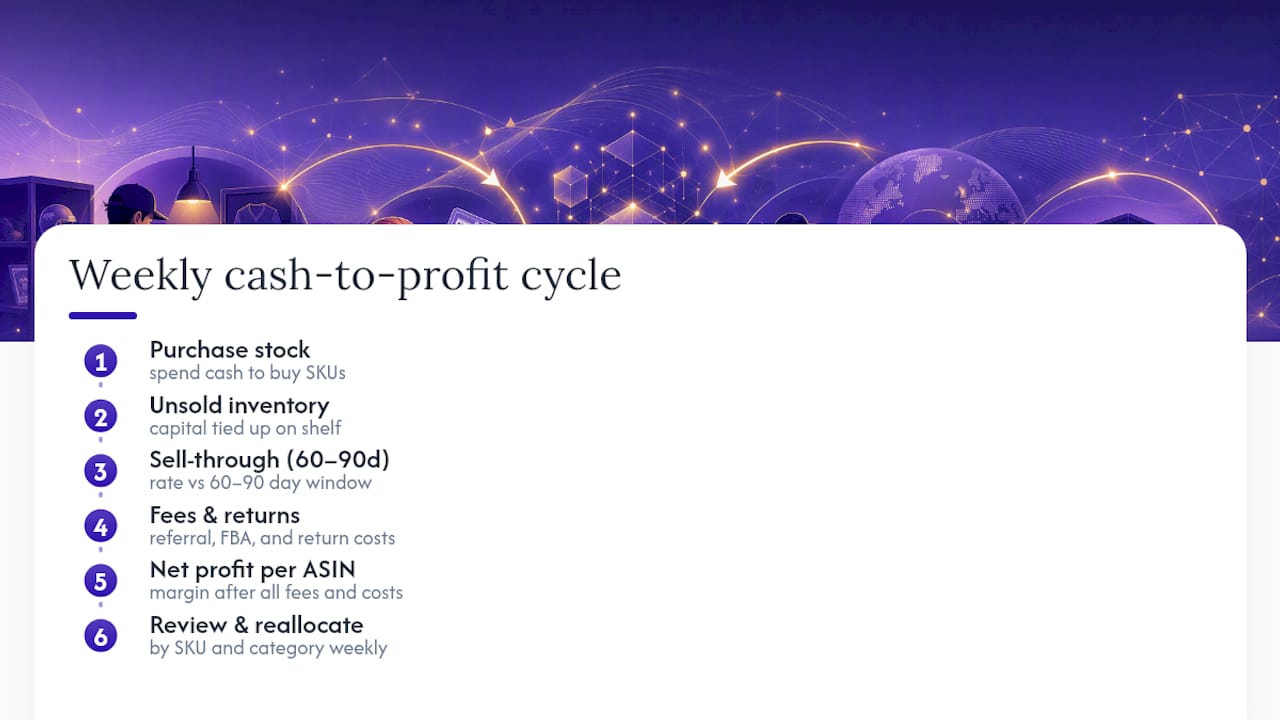
Profit trend reporting over time also catches slow fee creep, Amazon’s referral and fulfillment fees shift periodically, and a SKU that cleared a 25% margin six months ago might be sitting closer to 15% now without anyone noticing until a reorder decision gets made on outdated numbers. Reviewing profitability by category, not just by individual SKU, also tells you whether your sports niche focus is actually outperforming your other categories or just feeling productive because it moves fast.
Marketing and Customer Engagement Strategies to Boost Sales
Sports memorabilia and licensed gear sell partly on timing and partly on discoverability, and neither happens automatically once inventory is live.
Listing optimization matters more in this category than in generic goods because search terms shift with the season, a listing optimized for “playoff jersey” language in April needs different keyword emphasis by August. Update titles and bullet points ahead of known demand windows rather than after sales already start climbing.
Bundling related items, a team jersey with a matching cap or a fan accessory, tends to lift average order value without requiring separate inventory sourcing for each SKU. Cross-promotion across channels helps too: a listing that’s moving well on eBay can justify testing the same SKU on Amazon once you’ve confirmed real demand, rather than guessing blind on a new platform.
Customer engagement in this category leans heavily on trust signals. Buyers researching licensed gear or memorabilia adjacent products want to see clear condition descriptions, accurate sizing or specification details, and fast responses to pre-purchase questions. Sellers who answer authenticity and condition questions quickly convert better than sellers who let messages sit, particularly in a category where buyer skepticism runs higher than average.
Legal Considerations and Regulations Specific to This Category
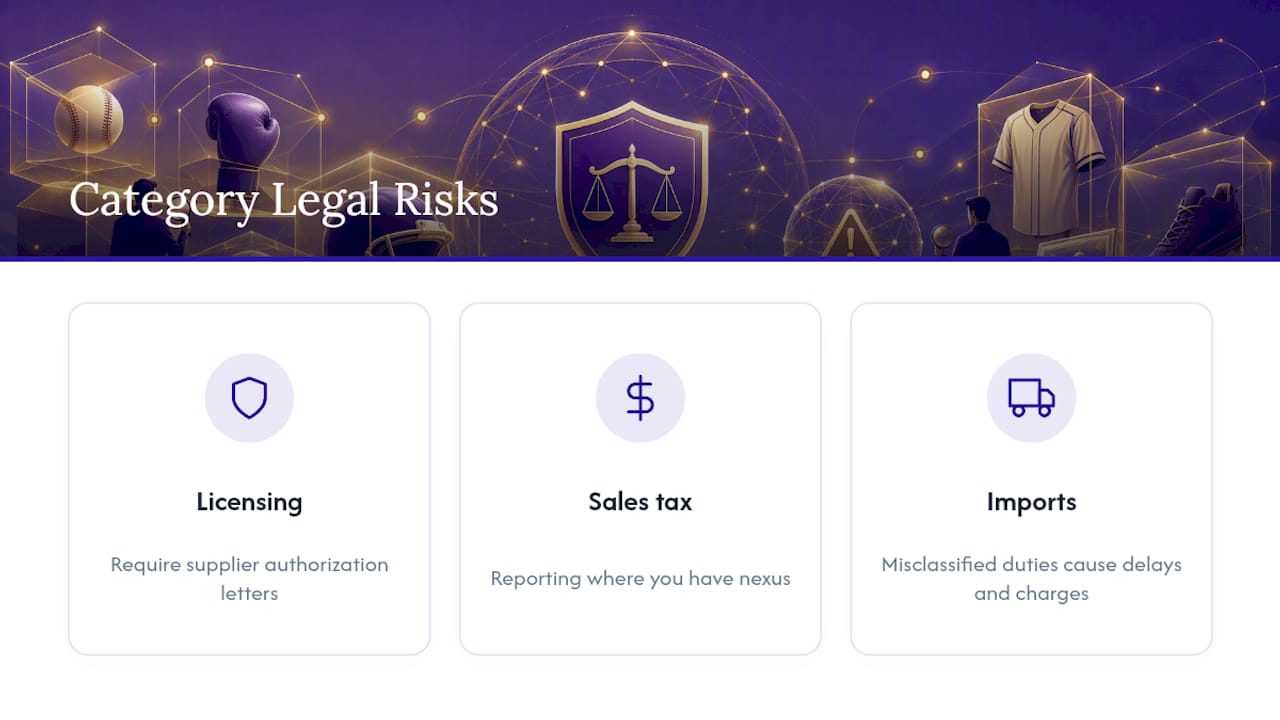
Licensed sports gear carries trademark and licensing exposure that generic wholesale categories don’t. Selling team logos, league marks, or player likeness merchandise without a supplier who holds legitimate licensing rights exposes your account to intellectual property complaints, which can trigger listing takedowns or account suspension even when you sourced in good faith.
This is exactly why brand authorization documentation matters so much earlier in this guide. A distributor who can produce a real authorization letter or a verifiable license chain is protecting you from a legal problem, not just a supply chain one.
Sales tax obligations also apply across the states where you have nexus, and marketplace facilitator laws mean Amazon collects and remits sales tax in most jurisdictions automatically, but you’re still responsible for understanding where your own reporting obligations begin, particularly if you sell across multiple platforms with different facilitator arrangements. Consult a tax professional familiar with multi-channel resale before assuming Amazon’s collection covers every obligation you have.
Import compliance adds another layer if you’re sourcing internationally. Duty classification errors on sports equipment or apparel can trigger customs delays or unexpected charges that blow your landed-cost math after the fact, another reason the 2026 sourcing trend data around rising duty exposure after de minimis changes deserves attention before you commit to a shipment.
Best Platforms Beyond Amazon for Sports Inventory
Amazon isn’t the only channel worth routing verified sports inventory through, and diversifying sales channels protects you when one marketplace’s fee structure or policy shifts.
eBay remains strong for licensed gear and accessories with clear model or size differentiation, particularly items with searchable specifics that buyers actively hunt for. Mercari and Poshmark skew toward apparel-adjacent sports gear and tend to reward fast shipping and responsive messaging over heavy SEO optimization. Depop leans younger and more style-driven, useful if your sourcing includes retro or streetwear-adjacent licensed apparel. Grailed and Vinted fit niche footwear and apparel crossover inventory better than mainstream equipment.
The operational discipline that works on StockX, get your highest bid accepted and ship within the platform’s tight window, applies broadly across these channels too. Resell-ready’s own breakdown of shipping fast on StockX covers the exact timing discipline that keeps seller ratings high across any marketplace with speed-based performance metrics. Routing the same verified SKU across two or three of these platforms, once you’ve confirmed real demand on one, spreads your risk without requiring separate sourcing relationships for each.
Author Perspective: Verified Suppliers and Landed-Cost Discipline Win
The sellers who scale past a few hundred units a month aren’t the ones who found the cheapest factory price. They’re the ones who never let a bad invoice or an unverified supplier into their pipeline in the first place. Discipline beats hunting for the lowest EXW quote every time margins get tight.
If you track one number obsessively, make it true landed cost per ASIN, weighed against capital exposure per SKU. Everything else, marketing tweaks, platform choice, timing, only matters once that number is right. A terminal that keeps this math current beats a spreadsheet that goes stale the week fees change.
— Christian
Resell Ready: The Operational Toolkit to Run This Playbook
Every step in this guide, supplier validation, landed-cost math, test-order sizing, replenishment timing, maps to a specific bottleneck spreadsheets handle poorly at scale. Resell-ready is the alternative to spreadsheet-based sourcing: paste an ASIN and get instant ROI and margin data instead of rebuilding formulas every week, and check the verified supplier database before you send a single outreach email.
If you’re testing sports memorabilia or licensed gear against footwear or general resale categories, run the numbers through the Sneaker Reselling ROI Tracker to see the margin comparison side by side. Sourcing in bulk or pallet quantities instead of single-unit MOQs? The Pallet Liquidation ROI Estimator runs that landed-cost scenario before you commit capital. Start with a free trial and run a single price-list CSV through the platform to see where your current sourcing math is leaking margin.
Sources
- How to find wholesalers — Amazon Selling Partner Blog
- Amazon Seller Central — seasonal timing guidance
- 2026 Sourcing Trends for Sports Support OEM/ODM | SKDK SPORT Buyer Pulse
FAQ
What Documents Does Amazon Require on a Wholesale Invoice?
Amazon wants supplier information, an itemized product list, an invoice date within the last 180 days, and buyer information matching your seller account, sometimes with minimum-unit evidence depending on the category, per Amazon’s own sourcing guidance.
How Big Should a Test Order Be for a New Sports SKU?
Most sellers test with the smallest MOQ tier a supplier offers, often 100 to 300 units according to current sourcing trend data, rather than committing to a full container before demand is confirmed.
What’s a Quick Way to Estimate True Landed Cost?
Add unit cost, packaging, labeling, freight, duties, and inbound FBA shipping, then subtract that total plus platform fees from your expected sale price to see the real margin before you place a PO.
How Fast Can I Validate a New Supplier Lead?
Check for a brand authorization listing, a verifiable business address and registration, and a sample invoice within a single outreach cycle. A supplier that stalls on any of those is rarely worth pursuing further.
Do I Need Inventory Into FBA Earlier Than 60 Days Before Peak?
Sixty to 90 days ahead is the minimum window Amazon’s guidance recommends, since listings inbound later than that usually launch cold against competitors with existing reviews and ranking.
Recommended
Ready to flip smarter?
ResellReady shows real sold prices, surfaces profitable deals, and builds your buying plan — the Basic plan starts with a 3-day free trial.
Get Started →