4 Checks Before You Wire: Spot Fake Sneakers for Resellers

4 Checks Before You Wire: Spot Fake Sneakers for Resellers
Require four things before you wire a dollar: a full SKU-level manifest with timestamped photos, verified supplier identity, pre-shipment samples with third-party inspection rights, and staged payment tied to those inspection results. Skip any one of them and you’re not sourcing inventory, you’re gambling with FBA fees attached. Every step below exists to protect that one rule.
TL;DR:
- Verifying a detailed SKU-level manifest, including condition, MSRP, and exact quantities, is critical for accurate ROI calculation and counterfeit risk mitigation.
- Confirm the supplier’s official registration, domain age, matching bank beneficiary, and brand authorization documents to prevent fraud and ensure legitimacy.
- Sampling should be proportional: 10-15% for small lots and standard AQL tables for larger lots; any defect or counterfeit indicators require shipment rejection.
- Digital verification tools like batch codes and QR scans must cross-reference manufacturer data and resolve to brand domains; they should complement, not replace, physical inspection.
- High-risk flags include unverifiable business info, mismatched bank accounts, refusal of third-party inspection, and lack of brand authorization, which necessitate immediate deal termination.
Looking for a tool to run the numbers? ResellReady's reseller profit calculator pulls live comps across eBay, Depop, Mercari, and Poshmark and calculates true net profit after fees. Compare plans and pricing — Basic starts with a 3-day free trial.
Table of Contents
- Pre-Purchase Document and Manifest Checks
- How Should You Sample and Inspect a Received Lot?
- Payment, Contracts, and Logistics Safeguards
- Digital Verification and Traceability: What Batch Codes and QR Scans Actually Prove
- Red Flags and Hard-Stop Rules
- Embedding Verification Into Your Sourcing Workflow
- Physical Characteristics That Still Matter During Sample Inspection
- Common Counterfeit Sneaker Brands and Models to Watch For
- Use of Technology Tools and Apps for Authentication
- How Sneaker Resale Market Trends Affect Counterfeit Detection
- Packaging and Labeling Authenticity Indicators
- Seller Reputation and Sales Channel Verification
- A Sourcing Lead’s Take on Why the Checklist Matters
- Where Resell Ready Fits Into Your Verification Stack
- Sources
Pre-Purchase Document and Manifest Checks
A manifest that just says “assorted sneakers, mixed sizes, 500 units” is not a manifest. It’s a liability waiting for a shipping label. Before you commit capital, demand a document that breaks the lot down to the SKU and UPC level, with exact quantities per style, a stated condition grade for each batch (new, deadstock, refurbished, damaged), and the original MSRP. Every one of those fields changes your ROI math and your legal exposure if the goods turn out to be counterfeit. A detailed SKU-level manifest is the primary tool for calculating resale value before you ever touch the inventory, and a seller who won’t produce one has already told you what you need to know.
Once the manifest is in hand, verify who actually sent it:
- Confirm business registration and tax ID against the country’s official registry, not just a PDF the seller emailed you.
- Run the supplier’s domain through a WHOIS lookup and check how long it’s been registered. A three-month-old domain moving five-figure sneaker lots is a pattern, not a coincidence.
- Match the bank beneficiary name on the invoice to the registered business name. Any mismatch is a stop sign, not a negotiating point.
- Request brand authorization letters or distributor certificates, then call or email the brand’s own contact channel to confirm the letter is real rather than a forged template.
Pricing tells its own story. A supplier vetting checklist built around these document checks turns a gut feeling into a paper trail you can point to later.
How Should You Sample and Inspect a Received Lot?
Documents get you to the negotiating table. Physical samples get you to a purchase order. Sampling percentages should scale with lot size: small lots under 500 units generally warrant inspecting 10% to 15% of units, while larger lots can use standard Acceptable Quality Level (AQL) sampling tables common in apparel and footwear inspection, typically AQL 2.5 for major defects on branded goods. Anything above that threshold on a legitimate brand run should trigger a hold, not a shrug.
- Pull samples across the full size run, not just a convenient handful from one carton.
- Photograph and video packaging, box codes, and labels before you open anything, then again after opening.
- Record batch or lot codes exactly as printed, including any that appear only inside the shoe or on an interior tag.
- Log timestamps and geolocation metadata on every image so the evidence can’t be disputed later.
- Store manifest snapshots, inspection PDFs, and correspondence together in one dated folder per lot, with a simple chain-of-custody note showing who handled the samples and when.
Pro Tip: Keep raw, unedited photo files rather than exports. A screenshot with stripped metadata is worthless if you ever need to dispute a chargeback or file a claim with the brand.
A failed sample isn’t a footnote, it’s a decision point. If defect rates exceed your AQL threshold or a single unit shows counterfeit indicators, refuse the shipment, freeze any staged payment immediately, and escalate to the brand’s anti-counterfeiting contact before the rest of the lot ever leaves the warehouse.
Payment, Contracts, and Logistics Safeguards
Payment structure is where most sourcing teams lose money even when everything else looked fine on paper. Favor escrow services, marketplace trade assurance programs, or letters of credit over direct wire transfers whenever a supplier is new.
Some rules have no exceptions:
- Never send payment to a personal bank account or an offshore account that doesn’t match the registered business name on the invoice. That single mismatch is one of the most severe supplier red flags in wholesale sourcing.
- Insist on contract language covering inspection rights, a stated AQL threshold, IP indemnity in case goods turn out counterfeit, and clear responsibility for return freight and customs fees if the lot fails inspection.
- Start with a small trial order on any new supplier and scale volume only after two or three clean cycles.
- Document mismatches across the invoice, the bank account, and the business register are the earliest and most reliable fraud signal, so treat any discrepancy as an automatic pause rather than a detail to sort out later.
Digital Verification and Traceability: What Batch Codes and QR Scans Actually Prove
Batch codes and QR/NFC tags are useful corroboration, never standalone proof. When you cross-check a batch code with a manufacturer, a legitimate brand typically responds within about three business days. A five-day silence or a copy-paste reply that doesn’t reference your specific batch number is itself a signal something is off.
A valid QR or NFC scan should redirect to a page hosted on the brand’s own verified domain, not a third-party site with a similar name. If the scan bounces you somewhere unrelated, or the landing page has no batch-specific data, treat the code as decorative rather than proof.
Serialized products saw a 40% reduction in counterfeit reports in 2025, which is exactly why serious brands have moved toward unique serial verification.
Blockchain-based traceability is gaining traction in luxury and footwear supply chains, and combining blockchain records with machine-learning anomaly detection can flag suspicious lots more reliably than a batch code alone. But adoption across sneaker manufacturing is still uneven, and a forged or misrouted digital record can pass a casual glance. Treat every digital check as one input among several:
- Cross-check batch codes directly with the manufacturer, never just with the seller who supplied the lot.
- Confirm QR/NFC destinations resolve to the brand’s own domain.
- Never accept a digital verification alone as your only acceptance criterion.
Red Flags and Hard-Stop Rules
Some findings should end a deal on the spot. High-severity hard stops include an unverifiable business registration, a request to pay a personal or offshore account, refusal to allow samples or third-party inspection, and no brand authorization documentation whatsoever.
When a high-severity flag appears, the sequence is simple:
- Put any staged payment on immediate hold.
- Demand a physical inspection before releasing another dollar.
- Call the brand’s own verification contact directly, not a number the supplier gave you.
- Walk away if the supplier resists any of the above. A supplier with nothing to hide has no reason to stall.
Embedding Verification Into Your Sourcing Workflow
The checks above only scale if they live in a repeatable pipeline: manifest intake, automated parsing and flagging, sample and inspection requests, then staged payment release tied to results. Build one evidence folder per lot holding manifest snapshots, inspection reports, timestamped photos, brand correspondence, and payment receipts, so a dispute never comes down to memory.
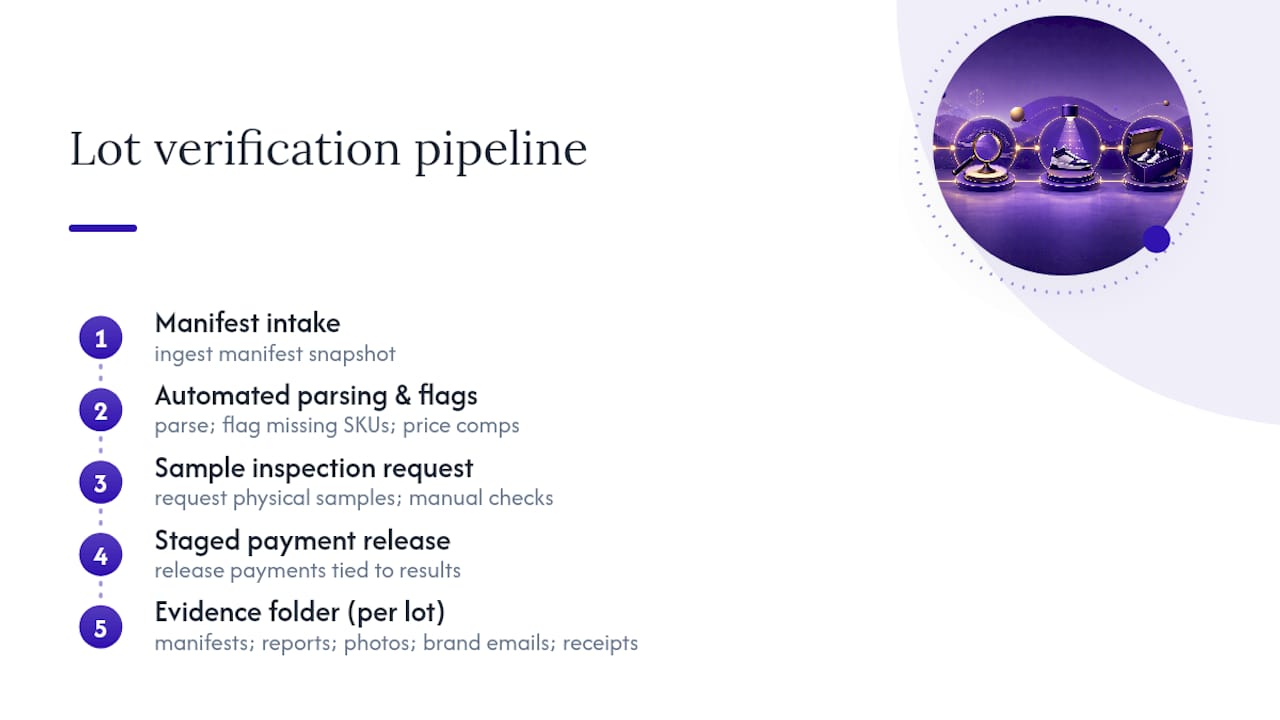
Automate what’s repetitive: price benchmarking against market comps, manifest parsing for missing SKU fields, and supplier-history flags across repeat orders. Keep physical sample inspection and brand phone verification manual, since those steps need human judgment a script can’t replicate. A verified B2B marketplace that vets sellers up front carries meaningfully less fraud risk than an anonymous liquidation auction site, so channel choice belongs in this workflow too.
Pro Tip: Run every new supplier’s first order through the full manual checklist, then only automate the flags once you’ve seen at least one clean cycle from that exact supplier.
Verified-supplier databases, manifest-parsing tools, ASIN and marketplace checks, and ROI trackers can fit directly into this pipeline, cutting the manual grunt work without removing the human checkpoints that actually catch fraud.
Physical Characteristics That Still Matter During Sample Inspection
Documents and payment structure catch most counterfeit lots before a box ever ships, but the physical sample check remains your last line of defense. Materials are the first tell: genuine uppers use consistent leather grain or knit density across the full size run, while counterfeit production often swaps materials mid-batch to cut cost, so a size 9 that feels noticeably different from a size 10 in the same SKU deserves a second look.
Stitching should run in straight, even rows with consistent thread tension. Skipped stitches, glue residue along seams, or asymmetrical stitch counts between a left and right shoe in the same box are common in rushed counterfeit production runs. Logo placement and embossing depth matter more than most sourcing teams expect: authentic logos sit at a consistent depth and angle across every unit in a batch, while counterfeit tooling drifts slightly from unit to unit because the molds themselves are often lower-quality copies.
Sole patterns are worth photographing at an angle under strong light. Genuine outsoles show sharp, consistent tread edges from injection molding; counterfeit soles frequently show soft or rounded tread edges, uneven color between the outsole and midsole, or a rubber smell stronger than the brand’s typical production standard. None of these checks replace the manifest and payment safeguards above, but they’re what your inspector should be looking at with sample units in hand.
Common Counterfeit Sneaker Brands and Models to Watch For
Counterfeit volume tracks resale demand, not brand loyalty. The models that dominate resale marketplaces are the same models that dominate counterfeit production, because counterfeiters chase whatever generates the fastest flip. High-demand basketball and running silhouettes from major athletic brands, along with limited-run collaboration releases, see disproportionately higher counterfeit rates than standard retail sneakers because margins on fakes scale with hype.
Limited or “hype” releases carry the highest counterfeit risk of any category, since scarcity itself drives buyers toward secondary channels with less oversight than an authorized retailer. Classic retro releases that get periodically reissued are another common target, because counterfeiters can reuse the same tooling across multiple years of reissues rather than retooling for a new design each season.
For sourcing teams, the practical takeaway isn’t a blacklist of specific models. It’s a risk multiplier: the higher the resale premium on a given style, the more scrutiny that lot deserves regardless of which brand name is on the box. A lot of low-hype, high-volume basics from an unfamiliar supplier is a different risk profile than a lot of limited-release collaborations at a steep discount, and your inspection intensity should shift accordingly.
Use of Technology Tools and Apps for Authentication
Authentication apps and manufacturer scanning tools have real value, but only as one layer among several. Apps that compare photos against a reference database can flag obvious mismatches quickly, which makes them useful for a first pass across a large sample set before a human inspector spends time on each unit.
The limitation professional resellers run into fastest is database coverage. These tools work best on high-volume, frequently counterfeited models where the reference database is deep, and they’re far less reliable on lower-volume styles or older releases where the training data is thin. Treat a “pass” from an authentication app as a reason to proceed to physical inspection, not a substitute for it.
Manufacturer-hosted verification, whether a batch-code lookup or a QR scan, sits in a different category because it ties back to the brand itself rather than a third-party comparison engine. That’s the digital check worth weighting most heavily, and it’s the one covered in more depth earlier in this guide. Any tool that promises instant, standalone authentication without cross-referencing the manufacturer directly should be treated as a convenience layer, not a verification system on its own.
How Sneaker Resale Market Trends Affect Counterfeit Detection
Resale demand and counterfeit sophistication move together, and that relationship changes how much scrutiny a given lot deserves. When a specific silhouette spikes in resale value, counterfeit production ramps up within weeks, often using higher-quality materials than counterfeiters bothered with a few years earlier because the margin now justifies the investment.
This has a direct operational consequence: the physical-inspection checks that reliably caught fakes two or three years ago on a given style may not catch this year’s production run of the same style. Counterfeiters iterate based on what gets caught, which means your inspection checklist needs periodic review rather than a one-time setup you never revisit.
Market cooling has the opposite effect. When resale premiums on a style drop, counterfeit volume for that specific model tends to taper off too, since the economics no longer justify the tooling investment. That’s not a reason to drop scrutiny entirely. Grey-market diversion, genuine product routed around authorized channels, doesn’t follow the same pattern and remains a risk even on cooling styles. A single traced batch code or test purchase frequently identifies where diverted stock is leaking from, which is a different investigation than chasing counterfeits but uses much of the same documentation trail.
Packaging and Labeling Authenticity Indicators
Packaging is often the fastest tell precisely because counterfeiters focus their budget on the shoe itself and treat the box as an afterthought. Box printing on genuine units uses consistent, sharp typography and color saturation across an entire production run, while counterfeit boxes frequently show slightly blurred text, inconsistent color between units in the same batch, or a matte finish where the genuine box uses gloss.

Interior labels deserve as much attention as the box exterior. Size tags, care labels, and country-of-origin stickers should match the manifest’s stated factory location and use consistent font and placement across every unit in the lot. A label that’s slightly askew, uses a different adhesive than the rest of the batch, or lists a country of origin inconsistent with the brand’s known manufacturing footprint for that model is worth flagging during sample inspection.
Barcodes and UPC stickers are worth scanning against the manifest during the sampling stage, not just eyeballing. A UPC that scans to a different product entirely, or doesn’t scan at all, is a documentation failure serious enough to pause the whole lot. Tissue paper, tags, and any accessory items included in the box (extra laces, dust bags, authenticity cards) should also match what the brand typically includes with that specific model, since counterfeiters often skip these low-visibility extras entirely.
Seller Reputation and Sales Channel Verification
The sales channel a lot moves through changes your baseline risk before you’ve even opened the manifest. Vetted B2B wholesale platforms that require seller verification and standardized manifests carry meaningfully less fraud exposure than anonymous liquidation auction sites, where buyer protections are minimal and seller identity can be difficult to confirm at all.
Seller history matters more than seller claims. Look for a track record of consistent, verifiable transactions rather than a handful of glowing reviews that could easily be fabricated. Request references from other resellers who’ve bought from the same supplier, and actually contact them rather than taking a supplier’s word for a reference list. A supplier with years of registered business history and a consistent pattern of clean inspections across multiple buyers is a fundamentally different risk than one with a six-month-old storefront and no verifiable transaction history.
Cross-reference the seller’s claimed brand relationships independently. A legitimate supplier should be able to produce distributor authorization letters and verifiable references without hesitation, and a supplier who stalls on that request while pushing you toward a faster close is telling you something important about how that relationship will go once you’ve already paid.
A Sourcing Lead’s Take on Why the Checklist Matters
A sourcing lead I spoke with described catching a mislabeled pallet by simply calling the brand about a batch code that didn’t match the manifest. The brand confirmed the code belonged to a different product line entirely. Payment was on escrow hold, so the team walked away clean. The lesson: the four-check protocol only works if nobody skips the call.
— Christian
Where Resell Ready Fits Into Your Verification Stack
Manual checks catch what automation can’t, but at real sourcing volume, someone still has to parse ten manifests a week, cross-check supplier history, and track ROI across every lot in flight. That’s the part worth automating. Dashboards that centralize verified-supplier signals, manifest parsing, ASIN and marketplace price checks, and ROI tracking allow teams to spend inspection time on the samples that actually need a human eye instead of retyping spreadsheet data.
If you’re running one or two suppliers and a handful of lots a month, the manual checklist above is enough on its own. Once you’re managing repeat suppliers across multiple categories, or trying to move fast on a hot lot before a competitor does, that’s when the automated flags earn their cost. The Sneaker Reselling ROI Tracker applies this directly to footwear flips, running margin math against live resale prices the moment a manifest lands. Pair it with the Pallet Liquidation ROI Estimator if you’re evaluating mixed lots rather than single-category sneaker runs. Start a trial and run your next incoming manifest through it before you release a single payment.
Sources
- Blockchain-based anti-counterfeiting management system for traceable luxury products (2026)
- Wholesale Product Logistics Checklist | Forthclear
- 25 Supplier Red Flags: Spot a Risky Vendor in 2026
- What Is Product Authenticity in Wholesale for Retailers – On Point Wholesale
Recommended
Ready to flip smarter?
ResellReady shows real sold prices, surfaces profitable deals, and builds your buying plan — the Basic plan starts with a 3-day free trial.
Get Started →