$20k–$50k Revenue: LLC or Sole Proprietor for Resellers

$20k–$50k Revenue: LLC or Sole Proprietor for Resellers
Most casual and early-stage resellers should stay a sole proprietor while testing products and building volume. The math and paperwork simply cost less than an LLC. Form an LLC once you’re carrying meaningful inventory, selling in higher-liability categories, hiring help, or need the credibility to open wholesale accounts. Either way, an LLC alone won’t cut your federal tax bill unless you later add an S-Corp election.
TL;DR:
- Resellers earning between $20,000 and $50,000 annually or holding substantial inventory should consider forming an LLC to protect assets and enhance credibility.
- The legal shield of an LLC can be compromised if personal and business finances are mixed, or if formalities like contracts and insurance are neglected.
- An LLC does not automatically reduce taxes; most owners stay on Schedule C unless they elect S-Corp status once profits exceed about $60,000 to $80,000 annually.
- Formation costs range from $50 to $200 in most states, with recurring fees like annual reports and franchise taxes, making cost considerations vital.
- Keeping detailed profit tracking and maintaining separate business accounts are key to preserving liability protection and making informed, timely entity decisions.
Looking for a tool to run the numbers? ResellReady's reseller profit calculator pulls live comps across eBay, Depop, Mercari, and Poshmark and calculates true net profit after fees. Compare plans and pricing — Basic starts with a 3-day free trial.
Table of Contents
- LLC vs Sole Proprietor for Resellers: A 1-Minute Decision Checklist
- Liability and Legal Protection: How Sole Proprietor and LLC Differ for Resellers
- Tax Treatment: Schedule C, Self-Employment Tax, and When S-Corp Makes Sense
- Costs, State Rules, and Administrative Overhead of Forming and Running an LLC
- When Should a Reseller Switch From Sole Proprietor to LLC? Practical Thresholds
- How to Form an LLC for Your Reselling Business
- Maintaining Liability Protection and Good Bookkeeping
- Tax Mechanics and Example Scenarios for Resellers
- Reseller-Focused Perspective and Practical Controls
- A Pragmatic Rule of Thumb for Resellers
- A Practical Next Step for Tracking Your Reseller Numbers
- Sources
LLC vs Sole Proprietor for Resellers: A 1-Minute Decision Checklist
If you’re selling a few thousand dollars a month in used electronics or thrifted apparel with no employees, staying a sole proprietor is the right call. The paperwork is nonexistent: you just report income on Schedule C when you file. But a few situations flip that answer fast.
Statistic Callout: Reseller-focused guidance points to revenue in the $20,000 to $50,000 range as the practical zone where forming an LLC starts to make sense, tied to inventory value and liability exposure rather than income alone.
Here’s the quick version:
- Under $20,000 in annual revenue, low-risk products, no employees: stay a sole proprietor, keep a dedicated business bank account, and track expenses closely.
- Approaching or past that threshold, or holding thousands in inventory: file Articles of Organization, get an EIN from the IRS, and open a business bank account under the LLC’s name.
- Selling supplements, electronics, or anything with recall or injury risk: move to an LLC sooner regardless of revenue, and get liability insurance quotes now.
- Signing wholesale supplier agreements or applying for net-30 terms: suppliers often want to see a registered entity before extending credit.
One reminder that trips people up: an LLC is not insurance. It separates your personal assets from business debts in most cases, but a general liability policy covers claims an LLC structure never touches, like a defective product injuring a customer.
Liability and Legal Protection: How Sole Proprietor and LLC Differ for Resellers
A sole proprietorship offers zero separation between you and your business. If a customer sues over a defective item you resold, or a supplier sues for an unpaid invoice, your personal bank account, car, and even your house are fair game for collection. There’s no legal wall. The IRS treats a sole proprietorship as an extension of you personally, not a separate entity, and that legal reality extends well past tax season into every lawsuit or collections case.
An LLC changes that by creating a distinct legal entity that owns the business’s assets and debts separately from yours. If your LLC gets sued over a bad batch of resold electronics, the plaintiff generally can only go after what the LLC owns, not your personal savings or home equity. That’s the entire pitch of forming one, and for resellers dealing with product defects, counterfeit disputes, or shipping damage claims, it’s a real shield.
But the shield has holes, and resellers hit them more often than they’d like to admit. Courts can “pierce the corporate veil” and hold you personally liable anyway if you:
- Commingle personal and business funds in the same account
- Sign a personal guarantee on a supplier credit line or lease
- Commit fraud or knowingly sell counterfeit or unsafe goods
- Ignore basic formalities like keeping business records separate from personal ones
That last point matters more for single-member LLCs than people expect. Because there’s no board or co-owner watching your behavior, it’s tempting to treat the LLC’s bank account like a personal wallet. Courts notice that pattern, and maintaining strict separation between business and personal finances is consistently cited as the difference between protection that holds up and protection that collapses the moment someone challenges it.
Pro Tip: Open a business checking account before you form the LLC, not after. Route every supplier payment and every marketplace payout through it from day one, so there’s no gap in your paper trail when you actually need the protection.
The practical controls that keep your liability shield intact aren’t complicated. Keep a separate business bank account and credit card. Sign contracts and invoices in the LLC’s name, never your own. Carry general liability insurance as a backup, since it pays out even in scenarios where the LLC structure alone wouldn’t protect you, like a product injury claim that exceeds what your LLC’s assets could cover.
Tax Treatment: Schedule C, Self-Employment Tax, and When S-Corp Makes Sense
Here’s the part that surprises most first-time LLC owners: forming one doesn’t change your federal tax bill by a single dollar on its own. The IRS treats a single-member LLC as a disregarded entity by default, meaning it’s taxed exactly like a sole proprietorship unless you file paperwork to elect something different. You still report income and expenses on Schedule C, and you still owe self-employment tax, currently 15.3% on net earnings, covering Social Security and Medicare.
That self-employment tax is where the real pain shows up as your reselling income grows. At a relatively high net profit level, you face significant self-employment tax, on top of regular income tax. This is the number that pushes profitable resellers to look at S-Corp election.
Electing S-Corp status (via Form 2553, filed with the IRS) changes the math by letting you split income into a “reasonable salary,” which is subject to payroll tax, and remaining profit taken as distributions, which is not. That split can meaningfully reduce your self-employment tax exposure once profit climbs high enough to justify it.
The catch is added cost and complexity:
- You now need to run actual payroll for yourself, with quarterly filings
- You’ll likely pay a payroll service and possibly a bookkeeper or accountant
- You must pay yourself a defensible “reasonable salary,” not an artificially low one
Reseller-focused analysis puts the added annual compliance cost of S-Corp status in the low thousands, which means the election generally doesn’t pay off until net profit clears somewhere in the $60,000 to $80,000 range. Below that, the payroll overhead eats the savings.
Costs, State Rules, and Administrative Overhead of Forming and Running an LLC
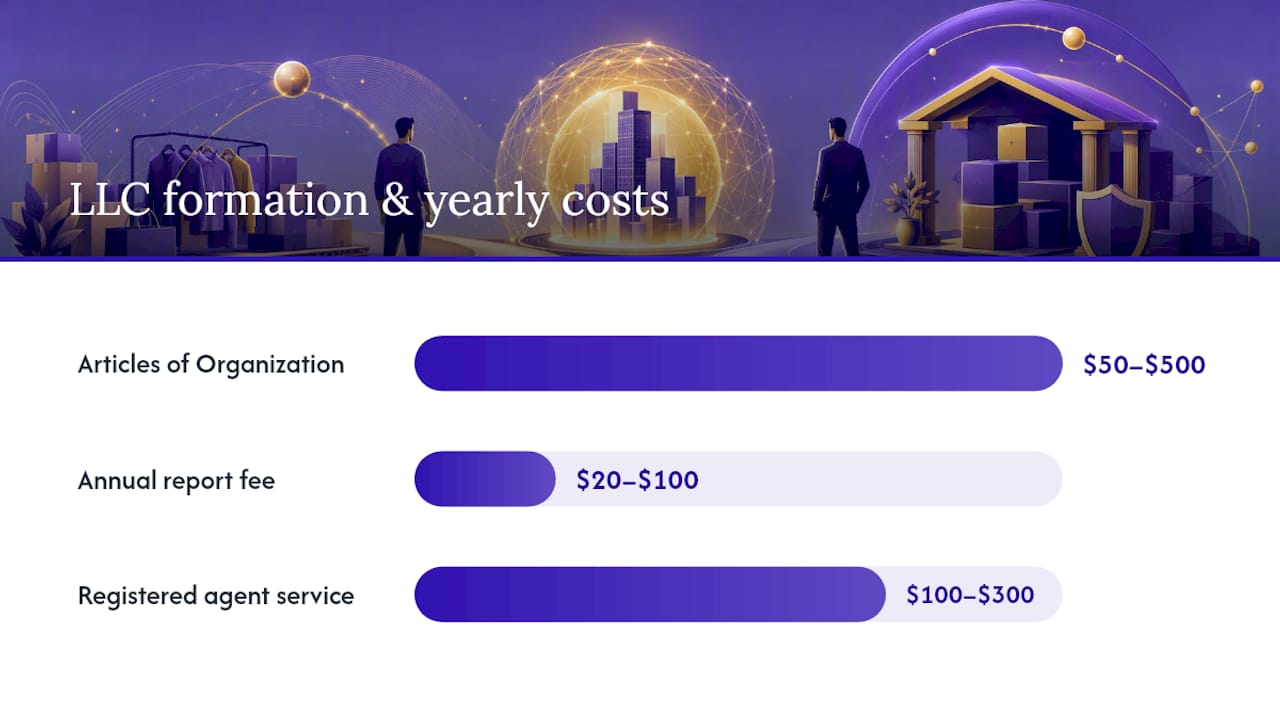
State filing fees vary widely, and this is where geography quietly changes your math. Initial formation fees for Articles of Organization commonly run somewhere between $50 and $500 depending on the state, with most states landing well under $200. That’s a one-time cost, but it’s not the only one.
Ongoing obligations are where resellers get caught off guard:
- Annual report fees: many states require a yearly or biennial filing, often $20 to $100, sometimes more
- Registered agent service: if you use a third-party registered agent instead of serving as your own, expect roughly $100 to $300 a year
- Franchise or annual LLC taxes: some states charge a flat annual tax regardless of income, which can run into the hundreds of dollars in higher-cost states
None of this is exotic. The SBA’s guide to business structures walks through the tradeoffs between formality and cost across every common entity type, and it’s worth reading before you pick a state to form in, especially if you’re weighing forming in your home state against a state with lower fees. A step-by-step state formation walkthrough is useful for seeing exactly what the paperwork and sequencing look like in practice.
Beyond legal fees, the real administrative shift is behavioral. You need a dedicated business bank account, disciplined bookkeeping, and clarity on whether you’re operating under a DBA (doing business as) name or the LLC’s formal registered name on marketplaces, invoices, and supplier accounts. Mixing those up on paperwork creates headaches later, particularly with resale certificates and sales tax permits, which need to match your registered business name exactly.
When Should a Reseller Switch From Sole Proprietor to LLC? Practical Thresholds
There’s no single revenue number that triggers the switch for everyone, but a few thresholds show up again and again in reseller guidance and among CPAs who work with online sellers.
- Revenue crossing $20,000 to $50,000 annually. This is the range where reseller-focused guidance most often flags LLC formation as worth the cost, since liability exposure and inventory value tend to scale together with revenue.
- Inventory value reaching a substantial amount. If a warehouse fire, theft, or shipping dispute could wipe out several thousand dollars of stock, that’s real exposure a sole proprietorship doesn’t cushion at all.
- Selling in higher-risk categories. Supplements, cosmetics, electronics with batteries, or anything a customer could plausibly claim caused injury or property damage. Product liability risk should push you toward an LLC faster than revenue alone. Categories like electronics carry distinct inventory and product-risk considerations worth mapping out before you scale volume.
- Hiring your first employee or contractor. Payroll and worker classification issues create liability that a sole proprietorship handles poorly.
- Opening wholesale or net-30 supplier accounts. Many wholesale suppliers simply won’t extend credit terms to an individual; they want to see a registered business entity on the application.
- Shipping high-value goods regularly. Higher per-unit value means higher per-claim exposure if something goes wrong in transit or a customer disputes a chargeback.
None of these triggers require hitting all six simultaneously. Even one, especially the product-risk or wholesale-account triggers, is often reason enough to formalize earlier than your revenue alone would suggest.
How to Form an LLC for Your Reselling Business
Forming an LLC is mostly paperwork, and it’s faster than people expect once you know the sequence.
- Choose your state of formation. Most resellers form in their home state to avoid extra foreign-entity registration fees, unless a specific state offers a meaningful cost or tax advantage for your situation.
- File Articles of Organization with your state’s Secretary of State office and pay the filing fee.
- Appoint a registered agent, either yourself (if you have a reliable physical address in the state) or a paid service.
- Draft an operating agreement. Even single-member LLCs should have one; it documents that you’re treating the LLC as a real entity, which matters if your liability protection is ever challenged in court.
- Get an EIN from the IRS. This is free and takes minutes online, and you’ll need it to open a business bank account.
- Open a dedicated business bank account and move all reselling income and expenses through it exclusively.
- Obtain your resale certificate and any required local licenses, then get liability insurance quotes before you scale inventory further.
Pro Tip: File for your EIN the same day your Articles of Organization are approved. Banks won’t open a business account without it, and every day of delay is another day you’re mixing funds in a personal account you’ll have to untangle later.
Maintaining Liability Protection and Good Bookkeeping
Forming the LLC is the easy part. Keeping the protection intact is where resellers slip up months or years later, usually without realizing it until a dispute forces the issue.
The bookkeeping rules are simple but need to be non-negotiable:
- Run every dollar of business income and expense through the dedicated business account, no exceptions
- Document any transfer between your personal and business accounts as a formal owner contribution or distribution
- Categorize expenses consistently, ideally month by month, so tax time doesn’t turn into archaeology
Insurance fills the gaps the LLC structure doesn’t cover. General liability insurance protects against customer injury or property damage claims. Product liability coverage matters specifically for resellers in categories like electronics, supplements, or children’s goods, where a defect claim could otherwise land directly on you. Business personal property coverage protects your inventory itself from fire, theft, or damage.
On the contract side, always sign supplier agreements, invoices, and marketplace paperwork under the LLC’s name rather than your own. Avoid personal guarantees on vendor credit lines whenever a supplier will accept the LLC’s credit standing alone. Every one of these habits either preserves the wall between your personal and business assets or quietly erodes it.
Pro Tip: Set a recurring monthly reminder to reconcile your business bank statement against your bookkeeping records. Small commingling mistakes are easy to fix in month one; they’re a legal liability by month twelve.
Tax Mechanics and Example Scenarios for Resellers
Numbers make this less abstract. Consider three resellers at different scales.
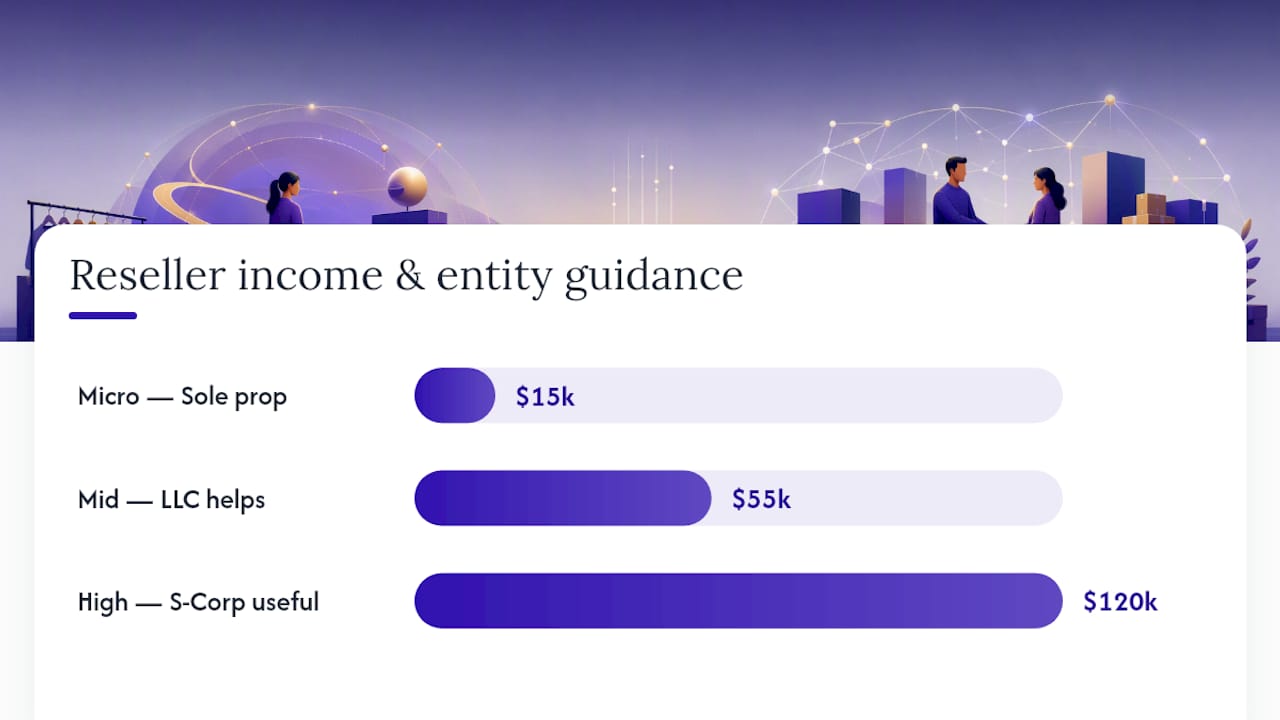
The micro seller, clearing $15,000 a year flipping thrifted clothing part-time, is best off staying a sole proprietor. Self-employment tax on that level of income can amount to a few thousand dollars, and an LLC’s filing fees and annual state costs would eat a real chunk of already-thin margins for protection this seller barely needs yet.
The mid-range seller, netting $55,000 a year reselling electronics with real product-liability exposure, sits in the zone where forming an LLC clearly helps, but S-Corp election is borderline. Self-employment tax on that net profit can be considerable, and payroll compliance costs for an S-Corp election could eat most of the projected savings at this income level.
The high-volume seller, netting $120,000 a year through wholesale sourcing and pallet liquidation, is a different story. Self-employment tax can exceed a substantial amount without any election. An S-Corp election letting them pay a reasonable salary of, say, $60,000 and take the rest as distributions can meaningfully cut that tax bill, even after payroll and accounting costs that typically run a few thousand dollars a year.
The pattern holds across all three: the bigger the profit, the more an S-Corp election is worth the added paperwork.
Reseller-Focused Perspective and Practical Controls
Entity decisions get a lot easier when you actually know your numbers, and that’s where most resellers fall down long before they get to the LLC question. If you don’t know your real net profit, including landed cost, shipping, platform fees, and returns, you can’t tell whether you’re near the $20,000 threshold or the S-Corp break-even point. You’re guessing.
Tracking inventory value and net profit consistently also removes the surprise factor when a tax or liability decision suddenly becomes urgent, like a supplier demanding proof of business standing or a CPA asking for clean records mid-filing season. Bring in a CPA once you’re seriously evaluating S-Corp election. The reasonable-salary requirement and payroll setup have enough nuance that a professional opinion easily pays for itself at that income level.
Automated profit and loss tracking, organized supplier records, and clear inventory valuation aren’t just bookkeeping hygiene. They’re what makes forming an LLC, and eventually electing S-Corp status, a low-risk decision instead of a leap of faith.
A Pragmatic Rule of Thumb for Resellers
The advice I keep coming back to is this: start simple, and formalize before you outgrow your protection, not after you need it. Waiting until after a lawsuit or a supplier dispute to form an LLC defeats the entire purpose.
Prioritize three things in order: a separate business bank account from day one, liability insurance once you’re carrying real inventory value, and reliable profit tracking so you actually know when you’ve crossed the thresholds that matter. Everything else, including the LLC paperwork itself, is easier once those three are in place.
— Christian
A Practical Next Step for Tracking Your Reseller Numbers
Once you’ve decided between staying a sole proprietor or forming an LLC, the harder ongoing problem is knowing your real numbers well enough to trust that decision. Software tools replace the spreadsheet guesswork with dashboards that track inventory value, net profit, and ROI in real time, so you’re never caught off guard by exactly the thresholds discussed above.

For sellers scaling into sneakers or streetwear, the sneaker reselling ROI tracker shows margin and capital exposure per SKU without manual entry. If you’re moving into pallet liquidation or wholesale lots, the pallet liquidation ROI estimator breaks down per-unit cost against resale comps before you commit capital. Both feed the same automated profit and loss view, which means the inventory-value and revenue thresholds covered above stop being estimates and start being numbers you can check in seconds. Start a free trial and run your current inventory through it before your next sourcing trip.
Sources
- Sole proprietorships (IRS)
- Choose your business structure (SBA)
- LLC vs Sole Proprietor for Resellers (ListingGenie)
- Do Resellers Actually Need an LLC? (Resell Calendar)
Recommended
Ready to flip smarter?
ResellReady shows real sold prices, surfaces profitable deals, and builds your buying plan — the Basic plan starts with a 3-day free trial.
Get Started →