4 Formulas That Power a Poshmark Pricing Strategy for Resellers

4 Formulas That Power a Poshmark Pricing Strategy for Resellers
Use recent Poshmark sold comps, never listing prices, and convert every result to net proceeds after fees and shipping. Set your list price above the median sold and hold a firm walk-away price based on landed cost. That single rule separates resellers who source on gut feel from those who source on math, and it works whether the item ends up back on Poshmark or in an Amazon FBA box.
TL;DR:
- Rely on recent sold comps, converted to net proceeds after fees and shipping, to set realistic target and walk-away prices for each item.
- Use scrapers or paid tools to reliably extract accurate sold data, focusing on sale date, condition, size, and discount specifics within the last 30 to 90 days.
- Ensure sample sizes are sufficient; lean on percentiles when fewer than 10 sales are available to avoid unreliable median prices.
- Route items to Amazon when net spread and sales velocity favor that platform, especially if FBA fees still leave a higher margin than Poshmark.
- Incorporate seasonal trends and adjust pricing frequently based on how median sold prices and demand change over time.
Looking for a tool to run the numbers? ResellReady's reseller profit calculator pulls live comps across eBay, Depop, Mercari, and Poshmark and calculates true net profit after fees. Compare plans and pricing — Basic starts with a 3-day free trial.
Table of Contents
- What Is a Poshmark Pricing Strategy Built on Sold Comps?
- Poshmark Fields to Extract and Why Each One Matters
- Where Do You Find Reliable Poshmark Sold Data?
- How Do You Calculate Net Proceeds and a Walk-Away Price?
- When Should You Route an Item to Amazon Instead of Poshmark?
- A Quick Checklist Before You Buy or List
- How Resell-ready Fits This Workflow
- How Do Seasonal Trends Affect Poshmark Pricing?
- Does Brand Reputation Change How You Should Price?
- How Do You Use Competitor Listings to Sharpen Your Own Pricing?
- What Psychological Pricing Tactics Work Best on Poshmark?
- How Should You Price Bundles and Handle Offers?
- What the Data Actually Tells You to Prioritize
- Automate Your Sold-Comp Pulls With Resell-ready
- Sources
What Is a Poshmark Pricing Strategy Built on Sold Comps?
A poshmark pricing strategy grounded in sold comps means pulling actual completed sales, not the asking prices sellers slap on active listings, and using that realized data to set both a target list price and a floor you won’t go below. This approach is common in retail arbitrage and online arbitrage practices; however, most beginner guides skip it entirely and just tell you to “check what similar items sell for” without explaining which fields actually matter.
Active listings tell you what sellers hope to get. Sold comps tell you what buyers actually paid. The gap between those two numbers is often significant on fashion resale, and pricing off the wrong one is the single most common reason resellers overpay for inventory or underprice a listing that could have sold for more.
Poshmark Fields to Extract and Why Each One Matters
Not every data point from a sold listing is worth your time. Some fields determine whether your comp set is valid; others just add noise. Here’s what to pull and why:
- Final sold price — the core number, but look at the full distribution, not just one sale. A single high sale can distort median prices if not viewed in context of other sales.
- Sold date and days-to-sell — velocity tells you whether an item moves in a week or sits for two months, which changes how aggressive your list price can be.
- Condition — “NWT” (new with tags) and “good used condition” comps should never be blended into the same median.
- Size, brand, and style tags — a men’s 10 sneaker and a men’s 11 in the same model can have wildly different sold prices; keep filters tight.
- Shipping terms and discounts — a $40 “sold” price that included a bundle discount or buyer-paid shipping isn’t the same $40 as a straight sale.
- Sample size — A small number of solds in a recent period produces a less reliable median; a larger number gives a more trustworthy estimate.
Skip any of these and you’ll build comps that look precise but are actually just noise dressed up as data.
Where Do You Find Reliable Poshmark Sold Data?
Poshmark’s public search interface shows you active listings and a rough “sold” filter, but it won’t give you exact sold dates, days-to-sell, or seller history at scale. There is no public API for sold listings on Poshmark, which is exactly why scrapers and paid data actors have become standard tools for serious resellers.
The poshmark-sold-listings actor on Apify pulls data straight from Poshmark’s search index and offers two modes: a fast mode for quick shape checks, and an enriched mode that returns soldAt, daysToSell, condition, and seller stats. A separate tool, the Poshmark Sold Listings Scraper, documents filter parameters like brand, minimum price, and maximum price, and its OpenAPI reference confirms exactly which fields you can expect back and reiterates that Poshmark has no public sold-data endpoint of its own.
Some practical guardrails before you scale a pull:
- Preview with 50 to 100 results first to confirm the filters return clean, relevant data before running a large batch.
- Pay-per-result pricing means costs scale linearly, so budget accordingly rather than pulling everything at once.
- Split deep pulls by brand or a tight price band to avoid hitting result caps and to keep comps from mixing quality tiers.
- Dedupe results and filter hard on brand, size, and condition before calculating any median.
- Remember that Poshmark’s search index typically surfaces sold data from roughly the last 30 to 90 days, so seasonal analysis needs repeated sampling over time, not a single snapshot.
How Do You Calculate Net Proceeds and a Walk-Away Price?
This is where sold comps turn into an actual buy or list decision. The math is simple enough to run in a spreadsheet column, and once it’s set up you can apply it to every item you scan.
- Calculate net proceeds per sold comp.
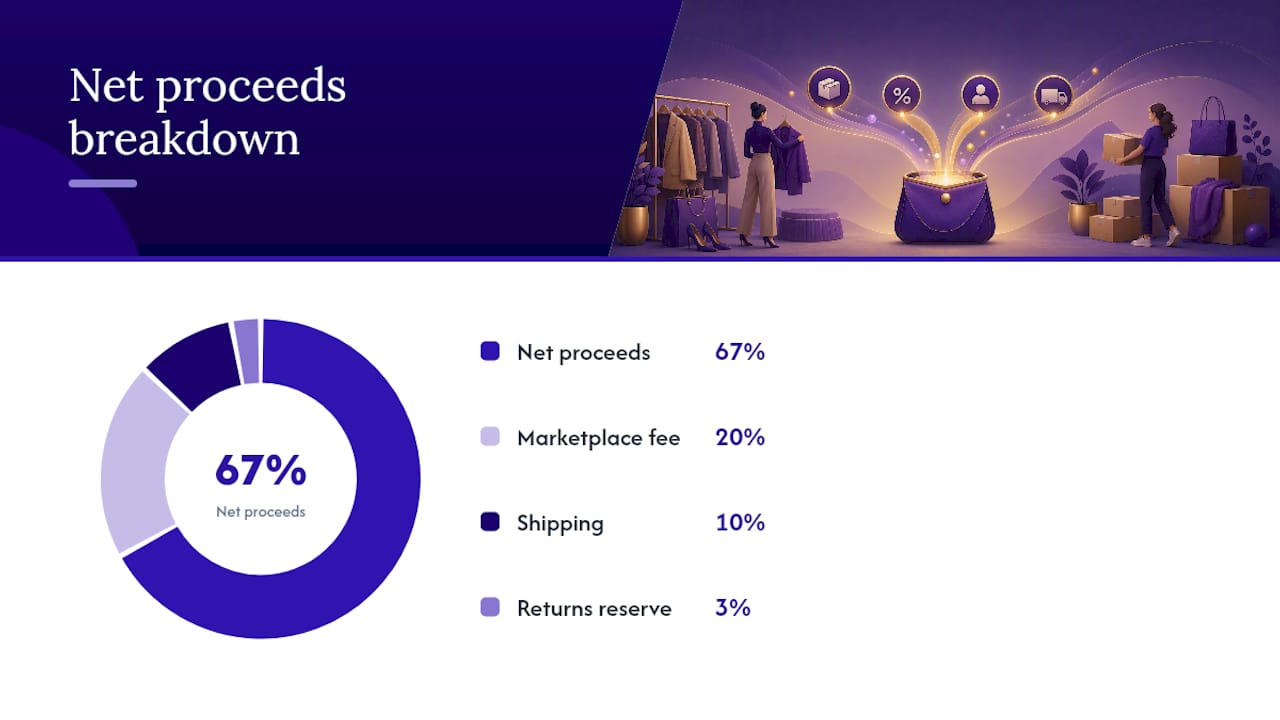
net_proceeds = sold_price − marketplace_fees − shipping − returns_reserve. On a $50 sold item with a 20% marketplace fee ($10), $5 in shipping, and a 3% returns reserve ($1.50), net proceeds land at $33.50. - Set your walk-away price.
walk_away = landed_cost + target_margin. If your landed cost (item plus inbound shipping and any prep) is a certain amount and you set a target margin, your walk-away price is the landed cost plus that margin. Below that, you don’t buy. - Set your list price off the median, not the outlier. Use
list_price = median_recent_sold + buffer. If the trailing 30 to 90 days of sold comps show a median of $42, add a 5% to 10% buffer and list around $44 to $46. - Choose median vs. percentiles based on sample size. With 10 or more solds, the median is reliable. With fewer, lean on the 25th percentile for a conservative walk-away and the 75th percentile only when you have real sold-count depth to back it up.
Pro Tip: Build these four formulas as live columns next to your sold-comp pulls. When the walk-away and list-price fields update automatically as you paste new comps, you stop re-deriving the math by hand every time you evaluate a lot.
For deeper fee breakdowns across marketplaces, the math behind Depop pricing and margin calculations follows the same logic and is worth cross-referencing if you sell across platforms.
When Should You Route an Item to Amazon Instead of Poshmark?
Sold comps don’t just tell you what to pay. They tell you where an item belongs. The decision comes down to comparing net spread, velocity, and fulfillment overhead across channels rather than just chasing the higher list price.
- Compare net spread after all costs on each channel. A $60 Poshmark comp with a $34 net proceeds figure might lose to a $48 Amazon FBA sale once you subtract FBA fees, storage, and prep, or it might win. Run both numbers.
- Use days-to-sell and sold-count as a velocity gate. An item with a 90-day median sell time on Poshmark but strong, consistent Amazon sales rank should route to FBA.
- Factor in FBA prep, storage fees, and return rates, which erode margin in ways a straight Poshmark sale doesn’t.
- Apply a simple decision rule: if net spread and velocity both favor Amazon, route it there; If Poshmark’s margin and velocity metrics are better than Amazon’s, listing there may be preferable.
This is the same screening logic behind the retail arbitrage data routine that ranks candidates by net-of-fees ROI instead of gross price gaps, and it applies just as well to a cross-market arbitrage workflow between eBay and Amazon.
A Quick Checklist Before You Buy or List
Run this sequence in a few minutes per item before committing capital:
- Pull sold comps with tight filters (brand, size, condition) over the trailing 30 to 90 days.
- Confirm sample size. If solds are under five, treat any median as fragile and lean conservative.
- Compute median sold price and days-to-sell to gauge both price and velocity.
- Calculate your walk-away price from landed cost, and set your list price at median plus buffer.
- Log the decision, set a watch alert on the comp set, and schedule a reprice check in two to three weeks.
How Resell-ready Fits This Workflow
Some advanced platforms automate most of the manual steps above. Bulk price checks can pull comps across multiple resale sites at once, so you’re not running one-off scraper pulls item by item. AI-powered buy/skip verdicts may apply net-proceeds and walk-away logic automatically, and watchlist alerts can flag when a price target hits; automated ROI and net profit tracking might replace spreadsheet columns many resellers build by hand.
How Do Seasonal Trends Affect Poshmark Pricing?
Sold comps from July won’t tell you what a wool coat sells for in November, and pricing off stale data is one of the fastest ways to leave money on the table. Poshmark demand shifts hard with weather, holidays, and back-to-school cycles, and the platform’s 30 to 90 day sold window means your comps naturally age out and need refreshing on a rolling basis.
Build reprice checkpoints tied to the calendar rather than a fixed date. Outerwear, boots, and holiday-specific items deserve a comp refresh every two to three weeks during their peak season, while off-season basics can go a full quarter between checks. When a category’s median sold price increases notably over time, that’s a signal to raise your list price on remaining inventory before demand cools. The reverse holds too: a falling median after a seasonal peak means it’s time to cut losses rather than sit on stock waiting for a price that won’t come back until next year.
Watch sold-count velocity alongside price. A rising median with a falling sold-count often means the market is thinning out at the top, not that demand is genuinely stronger.
Does Brand Reputation Change How You Should Price?
Brand and authenticity carry more pricing weight on Poshmark than on most general marketplaces, because buyers there are shopping for specific labels, not just categories. A well-known designer or a brand with a strong resale following will consistently show tighter, higher sold-price clusters than an unbranded or fast-fashion equivalent, even in similar condition.
Authenticity concerns cut the other way. Items in categories with high counterfeit risk, like luxury handbags or limited sneaker releases, often show a wider sold-price spread because buyers discount unverified listings and pay a premium for verified ones. If your comp set for a “designer” item shows unusually wide variance, check whether Poshmark’s authentication process applies to that category and price toward the lower end of the range until you can document provenance.
Don’t treat brand name alone as a pricing signal. A recognizable label with weak sold velocity, five items sitting unsold for 60-plus days, tells you the market has moved on regardless of what the name suggests. Sold comps correct for brand hype in a way that gut instinct never will.
How Do You Use Competitor Listings to Sharpen Your Own Pricing?
Sold comps set your baseline, but active competitor listings tell you what you’re up against right now. If five sellers are listing the same item at $35 with clean photos and detailed descriptions, and your sold comps show a $42 median, that gap is your opportunity, not a warning sign.
The quality of the listing affects sale price significantly. Listings with detailed photos and descriptions tend to sell better, even at higher prices. Before you undercut a competitor’s price, check whether their listing quality explains part of the gap. A weak listing at $30 isn’t necessarily the real market price if a strong listing with better photos is closing at $40.
Track how many competing active listings exist for your exact item and size. A crowded field with slow competitor sell-through despite low prices is a signal to price at or above your comps and invest in better listing quality rather than racing to the bottom.
What Psychological Pricing Tactics Work Best on Poshmark?
Poshmark’s offer system changes how buyers respond to price compared to a fixed-price marketplace. Listing slightly above your true target, then accepting offers that land at your actual walk-away number, tends to outperform listing at the bare minimum upfront, because it gives buyers the sense they negotiated a win.
Charm pricing, ending a price in $.00 rather than $.99, tends to signal a firmer, more considered price on Poshmark, where buyers already expect back-and-forth negotiation. A price like $48 reads as “this seller knows the value,” while $49.99 can read as padded for a discount that hasn’t happened yet.
Poshmark’s offer system allows targeted price drops to likely buyers, often improving conversion. Targeted offers to interested buyers can convert better than public price reductions, because it preserves your list price for other browsers while still moving inventory.
How Should You Price Bundles and Handle Offers?
Include bundle discounts in your walk-away calculations proactively before accepting offers, not calculated on the fly under pressure. If your walk-away price on three items is $60 combined, a bundle offer needs to clear that floor after Poshmark’s bundle discount and shipping are factored in, not just look good as a round number.
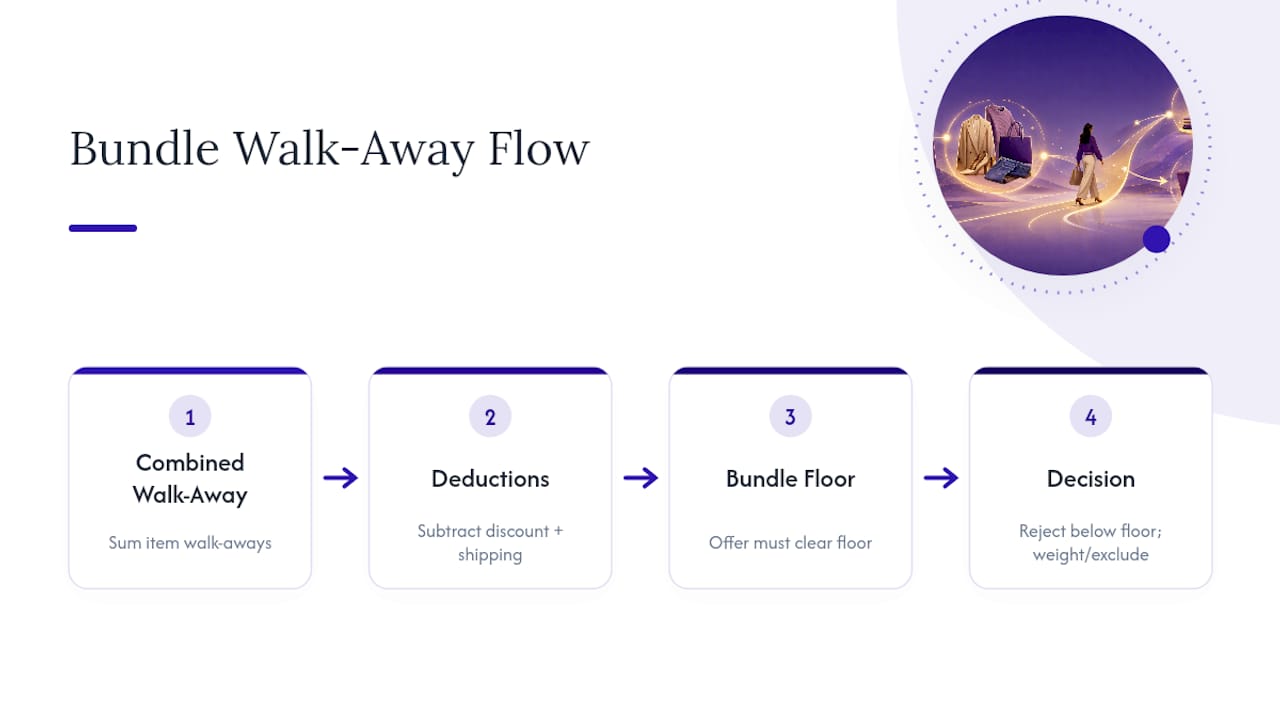
Avoid accepting bundle offers that price any item below its calculated walk-away price, even if the total feels attractive. Bundle sale prices may reflect combined discounts and are less straightforward to include in pricing analysis. Weight bundle solds lightly when building your median, or exclude them entirely if you’re pricing single-item inventory.
For counter-offers, set your minimum acceptable offer in advance based on the walk-away formula, and treat any number below it as a pass rather than a starting point for further negotiation.
What the Data Actually Tells You to Prioritize
Most advice on Poshmark pricing treats it as an art. Sold comps prove it’s closer to arithmetic. The key takeaway is that having clean, reliable data with adequate sample size matters more than pricing tactics A single lucky $80 sale sitting in a five-item comp set will wreck a walk-away calculation faster than any bad negotiation ever could.
Where conventional advice falls short is in treating list price as the finish line. Distinguish between list price as an initial offer and walk-away price as your minimum acceptable value. Sellers who conflate the two end up either overpaying at sourcing or underselling at listing, because they never separated “what I’d like to get” from “the number below which I don’t move.”
If you take one thing from this, prioritize the sample-size and percentile rules over the formulas themselves. The math is trivial once you trust the inputs. Getting comps clean, filtered, and deep enough to mean something is the actual skill, and it’s the part most resellers skip.
— Christian
Automate Your Sold-Comp Pulls With Resell-ready
Resell-ready is the alternative to running scrapers and spreadsheets by hand: bulk price checks across eBay, Depop, Mercari, Poshmark, Grailed, and Vinted return net-of-fees verdicts in the time it takes to paste a list of ASINs.

Instead of pulling comps one item at a time and rebuilding walk-away formulas for every category, Resell-ready runs the buy/skip logic automatically, tracks ROI and net profit per item, and flags watchlist targets the moment a price hits your threshold. For apparel-heavy inventory sourced against Poshmark comps, the Vintage Clothing Margin Calculator maps directly onto the fee and margin math covered above. Sellers moving lot or pallet volume can run the same logic through the Pallet Liquidation ROI Estimator. Start a trial and run your next sourcing list through it before your next buying trip.
Sources
Pull sold price, sold date, and days-to-sell directly with the poshmark-sold-listings actor or the Poshmark Sold Listings Scraper. For fee math on a comparable platform, see Depop shipping fees and payouts. For cross-listing workflow, check free tools to cross-list across platforms, and for general marketplace execution, selling successfully on eBay covers the listing-quality side of the equation.
- poshmark-sold-listings
- The Retail Arbitrage Data Routine: Spotting Underpriced Inventory Before Other Resellers | LogPose
Recommended
Ready to flip smarter?
ResellReady shows real sold prices, surfaces profitable deals, and builds your buying plan — the Basic plan starts with a 3-day free trial.
Get Started →