Fees Can Cut LEGO Reselling ROI 10–20%: What You Actually Keep

Fees Can Cut LEGO Reselling ROI 10–20%: What You Actually Keep
Yes, reselling LEGO can turn a real profit, but the headline “sold for triple retail” stories rarely survive contact with fees, shipping, and time. Your actual return hinges on three levers: how far below retail you bought, how much eBay or BrickLink take before you see a dime, and whether the set is retired or still sitting on shelves. Get all three right and you can beat inflation comfortably. Get one wrong and a “profitable” flip turns into a wash.
TL;DR:
- Buying LEGO sets at least 30% below retail price and accurately calculating fees and shipping is essential to achieving true profit margins.
- Platform differences significantly impact ROI, with eBay fees around 15%, BrickLink often lower, and local sales having no platform fees but limited buyer pools.
- Retired sets, especially from popular categories like Star Wars or Modular Buildings, tend to appreciate most within 12 months of retirement, but reissues or damage can impact value.
- Source sets from clearance sales, local marketplaces, or bulk lots, and verify condition carefully to maximize profit potential.
- Volume and turnover speed often matter more than high ROI per flip, so tracking all costs and sales is crucial for sustainable reselling.
Looking for a tool to run the numbers? ResellReady's reseller profit calculator pulls live comps across eBay, Depop, Mercari, and Poshmark and calculates true net profit after fees. Compare plans and pricing — Basic starts with a 3-day free trial.
Table of Contents
- What Is the Real LEGO Reselling ROI and Profit Formula?
- How Do eBay and BrickLink Fees Compare for LEGO Resale?
- What Makes a Retired LEGO Set Appreciate?
- Where Should You Source LEGO Sets to Flip?
- How Much Can You Realistically Earn Reselling LEGO?
- What Should You Track to Protect Your LEGO Resale Margins?
- Do You Have to Pay Taxes on LEGO Resale Profit?
- How Should You Price LEGO Sets to Maximize ROI?
- Do Limited Editions and Exclusive Sets Perform Better?
- A Realistic Take on Getting Started With LEGO Resale
- Where to Verify These Numbers Yourself
- Sources
What Is the Real LEGO Reselling ROI and Profit Formula?
Net profit isn’t sale price minus purchase price. It’s sale price, minus marketplace fees, plus or minus your shipping surplus or deficit, minus packaging, minus what you originally paid. Skip any of those and you’re measuring the wrong thing.
The formula, laid out step by step:
- Start with the final sale price.
- Subtract marketplace and payment processing fees.
- Add the difference between what you charged for shipping and what it actually cost (this can be negative).
- Subtract packaging materials, tape, and boxes.
- Subtract your original purchase price to get net profit.
- Divide net profit by purchase price for total ROI, then adjust for how long you held it.
Here’s a worked example using a set bought at a clearance discount:
Held for eight months, that 47.5% total return annualizes to roughly seventy percent, using the compound annualization method the Lego resale ROI calculator walks through. Annualizing matters because a 50% return over three years is a very different investment than the same 50% over three months. Without that conversion, you can’t compare two flips fairly, and you can’t decide whether your time is better spent on quick turns or patient holds.
How Do eBay and BrickLink Fees Compare for LEGO Resale?
Platform choice alone can swing your net ROI by 10 to 20 percentage points on an otherwise identical flip. That’s not a rounding error. It’s often the difference between a set being worth flipping at all.
- eBay’s combined marketplace and payment processing fees for collectibles commonly land in the mid-teens percentage range, according to detailed fee breakdowns from Do The Calculation.
- BrickLink’s commission structure plus payment processing frequently runs lower than eBay’s stack, though its buyer pool is smaller and slower for mainstream sets.
- Mercari sits somewhere in between, with fee structures that shift periodically, so check current rates before pricing.
- Local cash sales (Facebook Marketplace, in-person meetups) carry zero platform fees but cap your buyer pool to whoever’s nearby and willing to drive.
Shipping is the quiet profit killer. If you charge a flat $8 for shipping but a large Technic box costs $14 to ship in a properly sized carton, you’ve eaten $6 before fees even apply. Small, dense sets (Speed Champions, small Creator builds) tend to ship cheap relative to their value, which is exactly why they’re a popular starter flips. Large, boxy sets need real shipping math before you list, not after.
As a rule of thumb: use BrickLink for collector-grade, hard-to-find sets where its audience pays a premium, and eBay for anything with broad mainstream demand where volume and buyer traffic matter more than commission rate.
What Makes a Retired LEGO Set Appreciate?
Retirement is the single biggest price trigger in the secondary market. Once LEGO stops manufacturing a set, the fixed supply meets ongoing demand, and prices typically spike hardest in the first 12 months after retirement, then plateau or drift depending on the theme.
- Best-performing categories: Modular Buildings, UCS Star Wars, LEGO Ideas, and flagship Technic sets consistently show the largest median resale spreads, based on Upright Labs’ resale-market analysis, largely because of licensing scarcity and engineering complexity that discourages reissues.
- Why timing matters: Buying right before retirement (using retirement-date trackers) beats buying after prices have already spiked publicly.
- What kills the thesis: LEGO occasionally reissues a “retired” set under a new number, box damage tanks resale value fast, and a lot of viral “this set 10x’d” stories suffer from survivorship bias. Nobody posts about the sets that stayed flat.
Where Should You Source LEGO Sets to Flip?
Cheap sourcing is what makes the ROI math work in the first place. Pay retail and you’re fighting fees with very little margin left.
- Retail clearance: Target end-of-season and post-holiday clearance windows (January, late summer) when big-box retailers mark sets down 30 to 50%.
- Local marketplaces: Facebook Marketplace and estate sales often have sellers under time pressure, and patient buyers can land sets at 60 to 80% of broader market value simply because the seller wants cash now, not the best possible price.
- Bulk lots: Buying mixed lots or “for parts” collections can work if you’re willing to piece out rare minifigures and parts individually, though it adds hours of sorting labor.
- Condition check before buying: For sealed sets, inspect box corners, factory seal tape, and sun fading. For used-complete sets, verify piece count against the official inventory and check for missing minifigure accessories, which quietly tank resale value.
Reselling playbooks built for flipping Facebook Marketplace finds to eBay apply directly here. The same principle that finds underpriced items to flip in general merchandise works just as well scanning local LEGO listings.
How Much Can You Realistically Earn Reselling LEGO?
A hobbyist flipping five to ten sets a year, sourced mostly from clearance racks, might clear a few hundred dollars in net profit annually, treating it closer to a funded hobby than income. Part-time sellers running steady inventory of 20 to 50 sets can realistically build consistent monthly cash flow, but only if they’re tracking real net margins, not just headline sale prices.
- Hobbyist scale: Low volume, opportunistic buying, profit measured in beer money and covering the next purchase.
- Part-time scale: Regular sourcing routine, dozens of active listings, real but modest monthly income.
- Full-time scale: Specialization becomes necessary; theme-focused buying or minifigure part-out work raises margins but adds real operational complexity, since sorting a large set for parts can eat 10 to 40 hours of labor before anything sells.
Turnover, not headline ROI, usually decides whether your month feels profitable. A 60% ROI flip that takes 14 months to sell pays worse, dollar for dollar of your time, than a 25% ROI flip that turns over in six weeks. Capital efficiency, tracked the way ecommerce sellers watch budget efficiency through marketing efficiency ratio, matters more than any single set’s percentage gain.
What Should You Track to Protect Your LEGO Resale Margins?
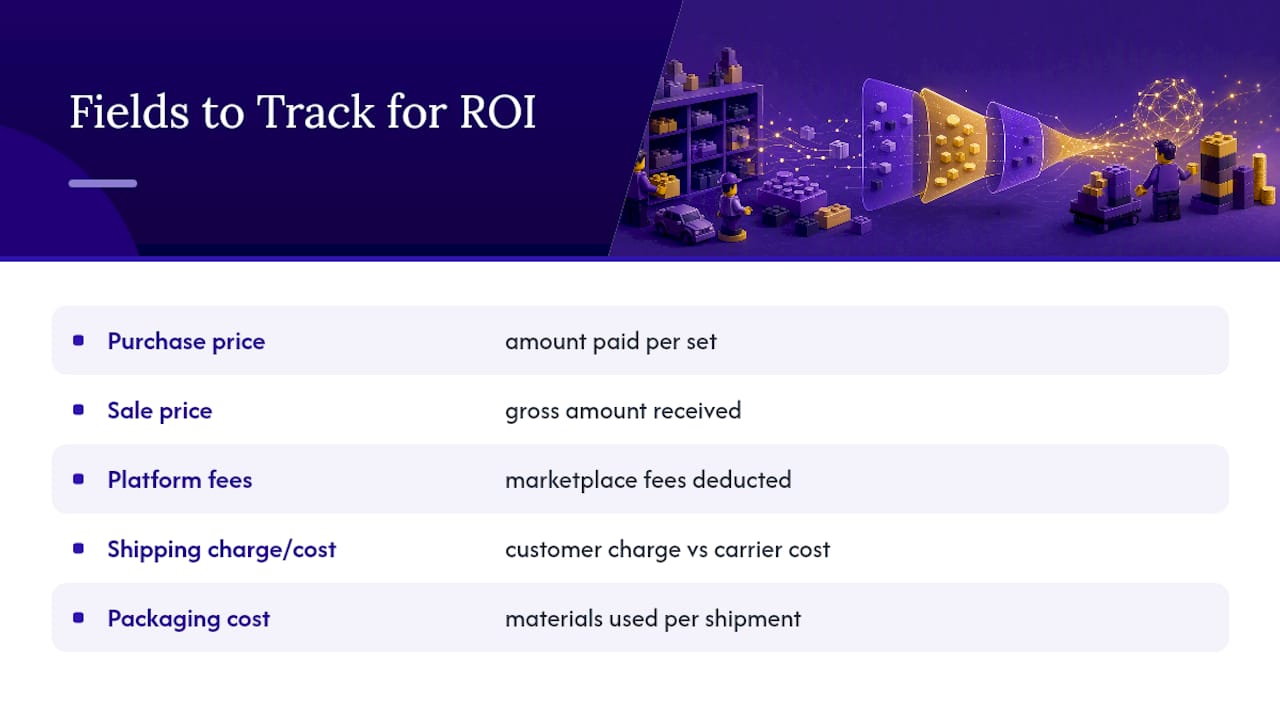
At minimum, record purchase price, sale price, platform fees, shipping charged versus actual cost, and packaging cost for every single sale. Miss any one of those fields and your ROI number is a guess, not a calculation.
A spreadsheet works fine at first, and there’s no shame in starting there. The problem shows up around set number 30 or 40, when manually pulling comps, tracking fee changes across platforms, and remembering which sets are approaching retirement becomes a part-time job on its own. That’s the point where automated tracking earns its keep: real-time ROI and net profit calculations, a running inventory dashboard, and price checks across marketplaces without you reopening ten browser tabs. Some specialized platforms handle that kind of tracking natively and offer verified supplier databases for sellers who source beyond retail clearance.
Pro Tip: Before you list anything, run a quick revenue leak checklist against your last ten sales. Most sellers find at least one fee or shipping miscalculation eating margin they didn’t notice.
Do You Have to Pay Taxes on LEGO Resale Profit?
Yes. In the United States, income from reselling LEGO sets is taxable, and the IRS treats regular, profit-seeking resale activity as business income rather than a casual hobby sale, which changes what you can deduct.
If you’re operating with intent to profit, on any regular basis, you generally owe self-employment tax on net profit in addition to ordinary income tax. That’s precisely why the “net profit” calculation from the ROI formula section matters beyond just knowing if a flip was worth it. It’s the number you’ll eventually report.
Deductible business expenses typically include your purchase cost, marketplace and payment processing fees, shipping and packaging materials, storage costs, and mileage driven to source inventory at local sales. Keep receipts and mileage logs; the IRS wants documentation, not estimates.
Payment platforms including eBay and PayPal issue Form 1099-K once you cross certain transaction thresholds, and those thresholds have shifted in recent years, so check current IRS guidance rather than relying on last year’s number. Even below the reporting threshold, you’re still legally required to report the income yourself.
This isn’t optional bookkeeping. A reseller running real volume without tracking net profit per sale is flying blind come tax season, scrambling to reconstruct a year of transactions from memory and bank statements. Consult a tax professional familiar with resale or gig income for guidance specific to your situation and state.
How Should You Price LEGO Sets to Maximize ROI?
Price against actual sold comps, not active listings. Active BrickLink and eBay listings show what sellers hope to get; sold history shows what buyers actually paid, and that gap is often 15 to 25% on mainstream sets.
Check completed sales in the last 30 to 60 days, filtered by condition (sealed, used-complete, missing pieces), and price your set inside that real range rather than at the top of what a handful of optimistic listings suggest. For sealed sets, box condition drives a meaningful spread. A pristine, unsunfaded box can command a genuine premium over a slightly crushed one of the identical set.

Price for demand curve, not just cost recovery. Setting your price to hit a target ROI percentage ignores whether anyone actually wants to buy at that number this month. A set that’s technically “worth” $150 based on comps but only moves at $130 because demand softened since your last check isn’t worth holding out on, especially with storage and opportunity cost ticking the whole time.
Reprice on a schedule, not never. Retired-set values shift as supply tightens or as a reissue rumor spreads. Sets that sit unsold for 60 to 90 days usually need a price cut, not more patience. The fee math from the eBay versus BrickLink comparison earlier also feeds directly into pricing: a set priced to net $80 after BrickLink’s lower fees might need to be listed several dollars higher on eBay just to clear the same net profit, so your listing price should never be identical across platforms.
Do Limited Editions and Exclusive Sets Perform Better?
Generally yes, but with a much wider spread of outcomes than mainstream sets, which makes them higher risk alongside the higher ceiling.
Exclusive releases, LEGO Ideas fan-designed sets, convention-only pieces, and store-exclusive variants benefit from hard supply caps from day one, not just eventual retirement. That built-in scarcity is why LEGO Ideas and UCS Star Wars sets show up repeatedly among the strongest performers in resale-market tracking. Licensing exclusivity adds another layer. A licensed set LEGO can’t easily re-issue due to contract terms tends to hold value better than a generic in-house theme that gets refreshed every few years.
The risk cuts both ways, though. Limited editions can also flop if the design itself doesn’t resonate. Not every convention exclusive or fan vote winner becomes a collector favorite. Buying purely on “limited edition” labeling, without checking actual demand signals like sold-listing velocity and price trend over the prior six months, is how sellers end up with capital tied up in a slow-moving box.
The practical takeaway: exclusive releases deserve a bigger allocation of buying budget than mainstream sets if you have the capital and patience, but they’re not a shortcut around research. Check sold comps and community sentiment before assuming “limited” automatically means “profitable.”
A Realistic Take on Getting Started With LEGO Resale
Quick flips beat long holds on annualized return almost every time, even when the long hold’s total percentage looks bigger on paper. Rookie mistakes cluster in three places: underestimating shipping cost on bulky sets, ignoring storage space until it’s a real problem, and forgetting that fees eat differently on every platform.
Start smaller than your ambition wants. Track every sale for 30 days, purchase price to net profit, before scaling volume or specializing. The numbers will tell you what to buy next far better than any theme guess.
— Christian
Where to Verify These Numbers Yourself
Run your own comps before trusting anyone’s averages, including this article’s. The academic study on LEGO’s long-run secondary-market returns gives historical context, the Lego resale ROI calculator handles the fee and annualization math, and Upright Labs’ market analysis tracks current retired-set demand by theme.
Sources
- Lego Resale Fees & Net Profit: What You Actually Keep After eBay, BrickLink, and Shipping | Do The Calculation
- Why LEGO Dominates the Online Resale Market (Upright Labs)
Recommended
Ready to flip smarter?
ResellReady shows real sold prices, surfaces profitable deals, and builds your buying plan — the Basic plan starts with a 3-day free trial.
Get Started →