10% or $0.80: Protect Reseller Margins From Facebook Marketplace Fees

10% or $0.80: Protect Reseller Margins From Facebook Marketplace Fees
If you use Marketplace shipping, Meta takes 10% of the buyer-paid total, or $0.80, whichever is higher, straight out of your payout. Sell for local pickup outside Marketplace checkout, and Facebook charges no fee. The fee base isn’t just your item price either. It includes whatever the buyer pays for shipping plus applicable tax, according to the platform’s official payout guidance.
TL;DR:
- Facebook charges a minimum fee of $0.80 or 10% of the total buyer-paid amount, including item price, shipping, and taxes.
- Shipping costs included in a sale increase the fee base, meaning charging $5 shipping on a $15 item results in a fee on $20, not just $15.
- Fees are higher for shipped items, especially bulky categories, compared to local pickup sales which have no Facebook fee.
- Moving checkout to Shopify shifts fee structure but adds payment processing costs and overheads that only pay off at high sales volumes.
- Tracking actual fee rates and using pricing formulas before listing helps protect margins and adapt to fee structure changes.
Looking for a tool to run the numbers? ResellReady's reseller profit calculator pulls live comps across eBay, Depop, Mercari, and Poshmark and calculates true net profit after fees. Compare plans and pricing — Basic starts with a 3-day free trial.
Table of Contents
- Facebook Marketplace Fees for Resellers: The Fee Formula Explained
- How Do You Calculate Your Facebook Marketplace Payout?
- Ways to Reduce Facebook Marketplace Fees on Your Listings
- When Does Facebook Pay Out, and What About Chargebacks?
- A Pricing Checklist to Protect Margins on Every Listing
- How ResellReady Turns Fee Math Into a Repeatable System
- What Are the Eligibility Criteria for Facebook Marketplace Fee Waivers?
- How Do Facebook Marketplace Fees Compare to Other Reseller Platforms?
- What’s the Real Impact of Marketplace Fees on Your Bottom Line?
- Has Facebook Changed Its Marketplace Fee Structure Recently?
- Do Marketplace Fees Vary by Product Category?
- Three Habits That Actually Protect Reseller Margins
- Model Your Fees Before You List, Not After You Get Paid
- Sources
Facebook Marketplace Fees for Resellers: The Fee Formula Explained
The math is simple once you see it written out: fee = the greater of $0.80, or 10% of (item price + buyer-paid shipping + tax). Facebook applies this to every shipped Marketplace transaction, according to the platform’s official payout guidance. There’s no tiered structure, no volume discount baked into the base rate, and no separate line item for shipping. It all gets lumped into one number before the percentage gets calculated.
That last part trips up a lot of resellers. If you charge $5 for shipping on a $15 item, Facebook isn’t taking 10% of $15. It’s taking 10% of $20. The fee base includes buyer-paid shipping and taxes, not just the item’s list price, which is a detail that’s easy to miss if you’re pricing off habit rather than doing the math each time.
Here’s how the fee behaves across different price points:
A few practical wrinkles worth flagging before you set prices:
- If you offer “free shipping” and bake the cost into the item price, you still pay 10% on that inflated price. Facebook doesn’t care how you label it.
- The $0.80 minimum means items selling shipped for a low total pay a higher effective percentage rate than the standard 10%.
- Fees can change. Meta has adjusted Marketplace commission structures before, including a fee increase, so the Commerce Help Center is the source to check before you lock in pricing rules, not a blog post from last year.
How Do You Calculate Your Facebook Marketplace Payout?
Numbers make this concrete faster than any explanation. Here are three scenarios that cover the range you’ll actually encounter as a reseller.
- Low-price shipped item. You sell a low-priced item with some buyer-paid shipping, and the fee is 10% of the buyer-paid total if that amount exceeds the minimum; this means your seller payout is the total minus the fee, and net profit accounts for your item and shipping costs.
- Mid-price shipped item. A typical mid-price shipped item includes a 10% fee on the buyer-paid total, subtract which from the total and your costs to find net profit; the inferred effective fee percentage against the item price varies accordingly.
- High-value local pickup. You sell a high-value item for local pickup, with no Facebook fee applied. Your net profit is the item price minus your costs and your time coordinating the meetup.
Pro Tip: Track your effective fee rate (total fee divided by item price, not buyer-paid total) for every sale type you use. It’s the number that actually tells you whether shipped listings are worth the hassle compared to local pickup for a given item category.
Independent fee calculators model this exact math and are worth bookmarking if you’d rather plug in numbers than run them by hand every time you list something.
Ways to Reduce Facebook Marketplace Fees on Your Listings
Facebook Shops connected to Shopify is the other real structural option. Instead of routing checkout through Marketplace, you sell through a connected storefront, which shifts payment processing away from Meta and can reduce the variable commission you’d otherwise pay on every sale, according to Shopify’s own guidance. The tradeoff is real, though. You take on payment-processing fees, storefront setup, and customer-service overhead that Marketplace handles for you by default. That investment tends to pay off only once you’re shipping at meaningful volume, not for someone flipping a dozen items a month.
A few pricing tactics also help:
- Build a small negotiation cushion into your list price so a haggled-down sale still clears your target margin after fees.
- Price shipping into the total rather than absorbing it, since the fee applies either way.
- Test a new category locally before committing to national shipping logistics.
Operationally, vetting buyers, requiring tracked shipping, and photographing item condition before you ship all reduce the odds you’ll eat a dispute later. Practitioner advice consistently points to local pickup as the default move for anything bulky or low-margin.
When Does Facebook Pay Out, and What About Chargebacks?
Facebook disburses payouts after delivery confirmation, with the selling fee already deducted, so sellers receive the net amount directly to their account.
Chargebacks complicate that timeline. When a buyer disputes a charge, Facebook can claw back the payout, and guides commonly report an additional administrative fee (often cited around $20) layered onto the lost sale, according to fee-tracking resources. That’s a double hit: you lose the item or the money, plus a penalty fee on top, and your cash flow takes an unplanned hole exactly when you weren’t expecting it.
A few habits reduce this risk substantially:
- Write listings that describe condition precisely, including flaws, so a buyer can’t credibly claim the item was misrepresented.
- Photograph every angle, including any wear, before you ship.
- Always ship with tracking, never with a service that leaves delivery unconfirmed.
- Log disputed sales separately in your bookkeeping so a chargeback doesn’t quietly distort your real margin numbers later.
A Pricing Checklist to Protect Margins on Every Listing
Run this sequence before you hit “publish” on a Marketplace listing, and you’ll rarely get blindsided by a fee you didn’t plan for.
- Add up your total cost: what you paid for the item plus any prep, cleaning, or packaging expense.
- Set your target net profit margin for that category (this varies by item type and how fast you need inventory to move).
- Add shipping cost if you’re covering it, or plan to pass it to the buyer if you’re pricing shipped listings.
- Estimate the Marketplace fee at 10% of your projected buyer-paid total, checking it against the $0.80 minimum.
- Solve for list price: (cost + target profit + shipping) ÷ 0.90 gives you the price needed to clear your margin after the fee.
Tracking your realized fees against these projections over a few weeks tells you where your pricing rules are off. Most resellers underestimate the drag from buyer-paid shipping inflating the fee base, and that gap only shows up once you check actual payouts against what you expected.
How ResellReady Turns Fee Math Into a Repeatable System
Running this formula by hand for every listing works until your volume climbs past a few dozen items a month. At that point, a dashboard that tracks ROI and net profit per sale, flags margin drift, and logs real payout data against your projections saves more than time. It catches pricing rules that quietly stopped working.
The resellers who protect margins consistently aren’t the ones who guess better. They’re the ones who feed real sale outcomes back into their pricing model instead of repricing off memory.
Bulk price checks and margin alerts built into a workflow like this remove the guesswork that creeps in when you’re juggling dozens of active listings across categories.
What Are the Eligibility Criteria for Facebook Marketplace Fee Waivers?
Facebook doesn’t publish a formal waiver program for individual resellers. The one built-in “waiver,” in practice, is the local pickup exception itself: any sale completed outside Marketplace’s checkout and shipping flow simply never triggers the fee in the first place.
Some sellers assume Facebook Shop verification or business account status changes the fee structure. It doesn’t, for standard Marketplace commerce transactions. The commission applies uniformly to shipped orders processed through Marketplace checkout regardless of account history or sales volume. The only path that meaningfully changes your fee exposure is moving checkout off Marketplace entirely, through a connected Shopify storefront via Facebook Shops, which changes who processes payment rather than granting a discount on the platform’s own rate.
If a seller ever encounters a special promotional period or a temporary fee adjustment, it will show up directly in the Commerce Help Center, not through a request process. Treat any third-party claim about “fee waiver eligibility” with skepticism unless it links back to Facebook’s own documentation, since Meta hasn’t built a discretionary discount system into Marketplace’s fee structure.
How Do Facebook Marketplace Fees Compare to Other Reseller Platforms?
Some platforms charge selling fees in the 12 to 20 percent range depending on category, then add a flat per-order processing fee on top. Others use tiered category-based commission structures where electronics and clothing carry different rates on the same platform. Facebook’s model, by contrast, charges one flat percentage across virtually all shipped goods with no category tiers, which makes it easier to model but doesn’t automatically make it cheaper.
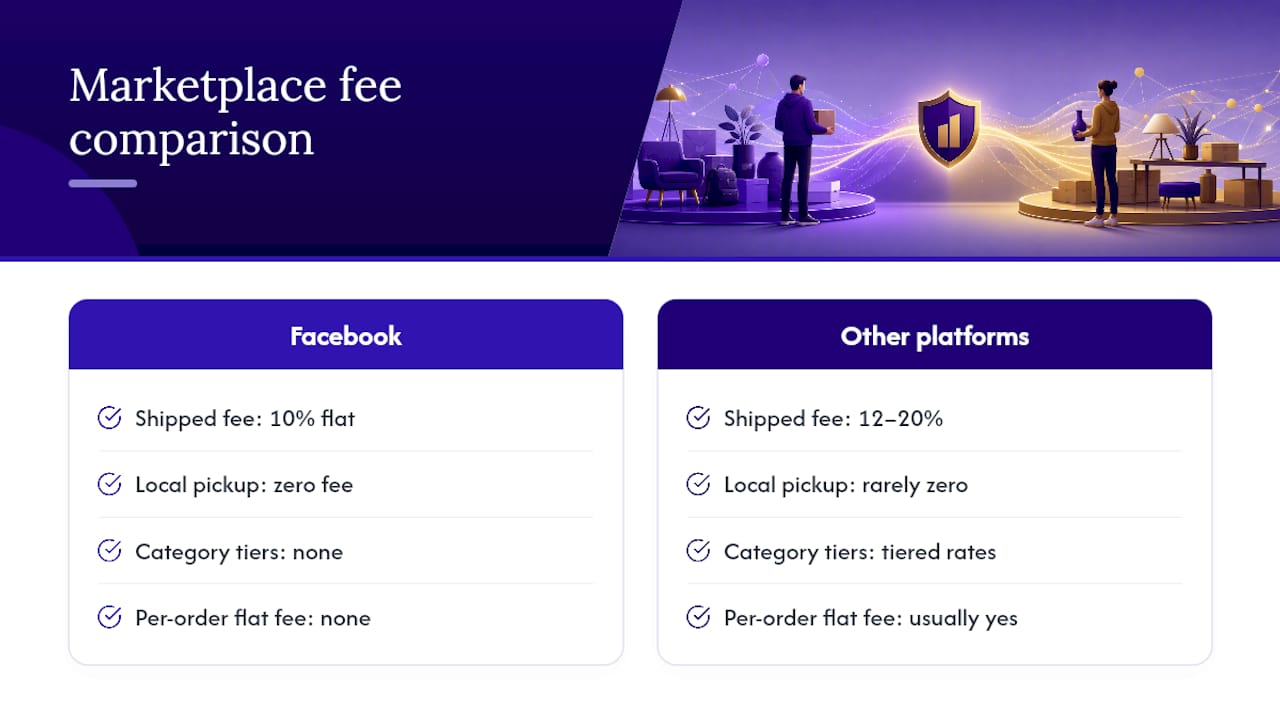
Where Facebook pulls ahead is the local pickup exception. Very few competing marketplaces let you route a sale to zero platform fee simply by handling logistics yourself. That single feature is why bulky, low-margin categories, furniture, appliances, large home goods, tend to perform better financially on Marketplace than on shipped-only platforms, even when Marketplace’s shipped rate looks comparable to a competitor’s blended cost.
Combined-cost estimates from independent calculator breakdowns put Facebook’s effective shipped cost around 12 to 13% once you factor in typical payment handling, close enough to competitors that the real differentiator for resellers is category mix and how often you can push sales to local pickup rather than the headline percentage itself.
What’s the Real Impact of Marketplace Fees on Your Bottom Line?
Flip the same item locally, and that margin stays intact. The gap between those two outcomes, repeated across dozens of listings a month, is often the difference between a reselling operation that scales and one that plateaus.

The compounding effect matters more than any single sale. Resellers who don’t separate these two percentages tend to overestimate how healthy their business actually is.
Category mix drives the real impact more than any single fee-avoidance trick. A reseller working primarily in low-cost, high-turnover categories (phone accessories, small electronics) feels the $0.80 minimum disproportionately, since it functions as a much higher effective rate on cheap items. A reseller in furniture or large appliances, where local pickup is the norm anyway, barely notices Marketplace fees at all. Knowing which bucket your inventory falls into changes whether fee optimization is worth the operational effort or a rounding error.
Has Facebook Changed Its Marketplace Fee Structure Recently?
Meta has adjusted Marketplace’s commission structure before, and the platform’s own payout documentation reflects a fee increase from where the shipped-order rate previously sat. That history matters for one reason: resellers who built pricing spreadsheets a year or two ago and never revisited them are likely running on outdated assumptions.
The practical lesson isn’t the specific historical rate, it’s the pattern. Marketplace fees aren’t fixed forever, and Meta can adjust them with limited advance notice to individual sellers. Treat any fee percentage you’ve memorized as provisional, and check the Commerce Help Center before you commit to a pricing model for a new product category or before you scale volume meaningfully.
This is also why relying on a scraped blog post from a year ago is risky. Fee guides go stale the moment Meta updates its policy, and a guide that isn’t dated or doesn’t link back to Facebook’s own page should be treated as a starting point, not a final answer, for your pricing math.
Do Marketplace Fees Vary by Product Category?
No. There’s no tiered commission table like you’ll find on some competing marketplaces, where electronics might carry a different rate than apparel.
What changes by category isn’t the fee rate, it’s how the fee interacts with your margin and your shipping decision. Bulky, heavy, or fragile categories (furniture, large appliances, exercise equipment) get hit twice: high shipping costs plus the fee calculated on top of an inflated buyer-paid total that includes that shipping. That’s precisely why local pickup dominates for these categories in practice, even though the fee rule itself doesn’t discriminate by what you’re selling.
One category-adjacent case worth knowing: resellers who source inventory in bulk, pallet liquidation being a common model, often break large lots into individual Marketplace listings. Since pallet items skew toward bulky, mixed-condition goods, the local pickup exception tends to matter more for this reselling model than for someone flipping small, shippable items sourced one at a time.
Three Habits That Actually Protect Reseller Margins
Prioritize local pickup for anything heavy or thin-margin. Review your actual realized fees weekly against what you projected, not just once a quarter. Standardize your shipping process and return policy across every listing so disputes stay rare instead of eating into a month’s profit unpredictably.
— Christian
Model Your Fees Before You List, Not After You Get Paid
Every example in this guide assumes you know your numbers before you hit publish. That’s the gap ResellReady closes for professional resellers who’d rather see projected payout and net profit up front than reverse-engineer it from a bank deposit. The platform’s ROI and net-profit tracking pulls real fee data into your dashboard so pricing decisions are based on what actually landed last month, not a rough guess.

If you’re flipping sneakers or similar high-turnover inventory, the Sneaker Reselling ROI Tracker applies this exact fee math automatically against your sourcing costs, so you see your real margin before you commit to a shipped listing versus a local pickup. Pair that with automated P&L tracking, and pricing stops being a spreadsheet chore. Start a trial and run your next batch of listings through it before you set a single price.
Sources
- When you’ll get paid for selling with shipping on Facebook Marketplace — Facebook Help
- How to sell on Facebook (Shopify guidance)
- Facebook Marketplace Fee Calculator: 10% Ship or $0 Local — SellerFeeCalc
- Here’s how one seller made money selling on Facebook Marketplace — NerdWallet
Recommended
Ready to flip smarter?
ResellReady shows real sold prices, surfaces profitable deals, and builds your buying plan — the Basic plan starts with a 3-day free trial.
Get Started →