Amazon Seller Fees 2025 Breakdown: What Actually Changed

Amazon Seller Fees 2025 Breakdown: What Actually Changed
Amazon held the line on referral and FBA fees in 2025, no rate hikes, no new fee categories, but it did rework the inbound placement service fee in ways that matter for anyone shipping bulky or split inventory. The real margin threats haven’t moved: seasonal storage spikes and peak fulfillment premiums still do the most damage. If you’re tracking one thing this year, track how inbound placement, storage timing, and refund admin fees interact on your highest-volume SKUs.
TL;DR:
- The inbound placement service fee has been reworked in 2025, especially affecting shipments split across multiple fulfillment centers.
- Seasonal storage costs spike from October to December, with long-term storage surcharges applying after 181 days in the warehouse.
- Peak fulfillment premiums from October 15 to January 14 can add up to $2.73 per unit, potentially eroding profit margins on high-volume SKUs.
- Using a detailed landed cost calculation and automating fee tracking helps maintain margins amid fee updates and seasonal fee changes.
- Keeping inventory moving within 150 days and consolidating shipments can prevent margin loss from storage surcharges and split-shipment fees.
Looking for a tool to run the numbers? ResellReady's reseller profit calculator pulls live comps across eBay, Depop, Mercari, and Poshmark and calculates true net profit after fees. Compare plans and pricing — Basic starts with a 3-day free trial.
Table of Contents
- Etsy Seller Fees Breakdown 2025: The Monthly Checklist
- Selling Plans and Referral Fees: The Real Break-Even Math
- FBA Fulfillment Fees and the Peak-Season Markup
- Storage Fees: Where Slow Inventory Quietly Bleeds Margin
- Inbound Placement and Unplanned Fees: The Surprise Line Items
- The Per-Unit Landed Cost Formula (With a Worked Example)
- Margin-Protection Tactics That Actually Work in 2026
- How Resell Ready Handles the Fee Math Behind the Scenes
- Resell Ready: Turn This Fee Math Into a Live Margin Check
- Where to Verify These Numbers Yourself
- Sources
Etsy Seller Fees Breakdown 2025: The Monthly Checklist
Before diving into rates, know what you’re actually tracking each month. This is the operational sense of an Etsy seller fees breakdown 2025, applied to your Amazon P&L, and it’s the checklist agencies should run against every client account.
- Selling plan (fixed): Individual per-item charge or Professional monthly subscription.
- Referral fee (variable, percent of sale price): category-dependent, charged on every order.
- FBA fulfillment fee (variable by size/weight tier): charged per unit shipped.
- Storage fees (variable and seasonal): monthly cubic-foot charge, spikes in Q4.
- Inbound placement fee (variable, shipment-dependent): triggered by split shipments.
- Refund administration fee (variable): charged when a customer returns an item.
- Returns processing costs (variable): grading, repackaging, or write-off.
- Unplanned service fees (exception-based): labeling, polybagging, manual prep.
- Advertising spend (variable, discretionary): allocated per campaign, not per unit, but it belongs in the same monthly review.
Fixed costs are predictable. Variable and seasonal costs are where margin quietly disappears.
Selling Plans and Referral Fees: The Real Break-Even Math
Amazon’s two selling plans are Individual, at $0.99 per item sold, and Professional, at $39.99 a month regardless of volume. The math is simple: sell more than 40 units a month and Professional wins. Most serious resellers cross that line in their first few weeks.
Referral fees are where category matters more than plan choice. Rates typically run 8% to 15% of the item’s total sale price depending on category, with most categories carrying a minimum referral fee (often $0.30) so ultra-cheap items don’t get sold at a loss to Amazon’s cut alone.
Statistic Callout: A refund administration fee is charged when a customer returns an item, calculated as the lesser of a fixed dollar amount or a percentage of the original referral fee. On a $30 item with a 15% referral fee ($4.50), a refund costs you $0.90, not the full referral fee back. That gap between “expected refund” and “actual refund” is where a lot of sellers miscalculate their reserve.
- Individual plan: fine under roughly 40 units/month.
- Professional plan: better economics past that threshold, plus access to bulk tools and advertising.
- Referral fee minimums matter most on sub $10 items.
FBA Fulfillment Fees and the Peak-Season Markup
Fulfillment fees scale with size and weight tier, not just price. A small standard item might run a couple dollars per unit; a large standard item can run several dollars more once dimensional weight kicks in. Category also matters. Apparel and oversized goods often carry different handling costs than a compact electronics item of similar weight.
The bigger swing is timing. From October 15 through January 14, Amazon applies a peak-period fulfillment uplift that can add roughly $0.19 to $2.73 per unit depending on tier. That’s not a rounding error on thin-margin resale items, it can erase the profit on a SKU that looked fine in August.
| Tier category | Typical fulfillment fee range | Peak-period add-on (Oct 15–Jan 14) |
|---|---|---|
| Small standard | Roughly $3 to $4 per unit | Lower end of the uplift range |
| Large standard | Roughly $4 to $6 per unit | Mid-range uplift |
| Large bulky / oversized | Roughly $8+ per unit | Higher end of the uplift range |
Run your Q4 numbers with the uplift baked in, not as an afterthought after the invoice lands.
Storage Fees: Where Slow Inventory Quietly Bleeds Margin
Monthly storage is billed per cubic foot, and the off-peak rate you pay from January through September roughly doubles or more once you hit the October to December peak window. A SKU that costs pennies to store in the summer can cost several times that heading into the holidays.
Statistic Callout: Long-term storage surcharges begin kicking in after 181 days in a fulfillment center, with much steeper penalties once inventory crosses the 365-day mark. That’s the fee line that turns a mediocre buy into a guaranteed loss.
To convert the cubic-foot rate into something useful, measure your unit’s actual volume, multiply by the applicable rate, and divide by units per case. A shoebox-sized item at a few cents per cubic foot monthly adds up fast across a few hundred units sitting through Q4.
- Off-peak storage: lower per-cubic-foot rate, January through September.
- Peak storage: substantially higher rate, October through December.
- Long-term surcharge: triggers at 181 days, worsens at 365 days.
If a SKU isn’t moving by September, schedule a removal or a clearance promo before the peak rate and the aging clock both work against you.
Inbound Placement and Unplanned Fees: The Surprise Line Items
Amazon charges the inbound placement service fee when your shipment gets split across multiple fulfillment centers instead of landing in one place. Split shipments cost Amazon more to distribute, and that cost gets passed to you, sometimes without much warning if you haven’t optimized your shipping plan.

The January 15, 2025 update actually helped here: Amazon lowered placement fees for certain large bulky items and introduced timebound waivers for qualifying new parent ASINs between December 2024 and March 2025. If you launched new products in that window, check whether you captured the waiver.
Beyond placement, watch for these common unplanned service fees:
- Labeling corrections: roughly $0.30 per unit when FNSKU labels are missing or wrong.
- Polybagging/prep: roughly $0.70 per unit for items needing added prep.
- Manual processing: variable, but avoidable almost entirely with correct prep upfront.
Pro Tip: Consolidate inbound shipments into fewer, larger boxes instead of many small ones. It’s the single fastest way to cut placement fee exposure without changing anything about the product itself.
The Per-Unit Landed Cost Formula (With a Worked Example)
Every fee line above only matters once you fold it into a single number: what does this unit actually cost you to sell? Use this formula:
Landed cost per unit = product cost + inbound shipping + prep + allocated inbound placement fee + allocated storage + FBA fulfillment fee + referral fee + returns reserve + advertising allocation.
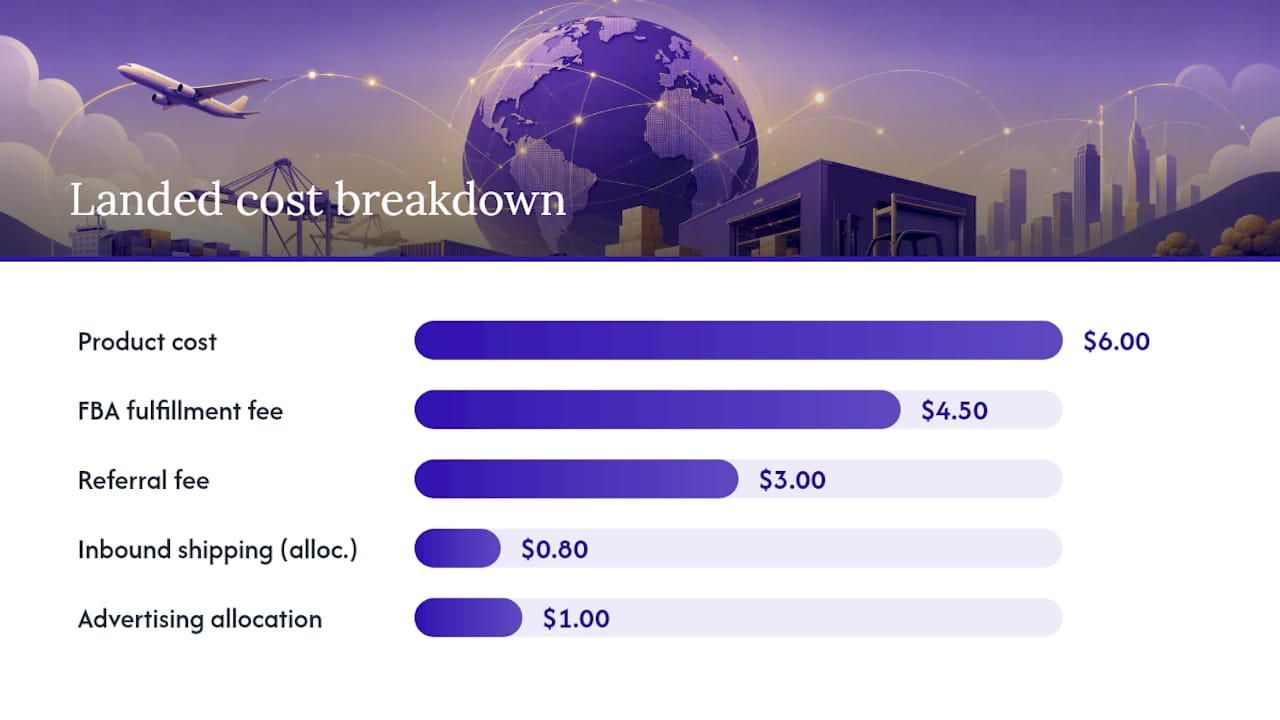
Here’s a worked example on a $20 resale item, large standard tier, sold outside peak season:
- Product cost: $6.00
- Inbound shipping (allocated): $0.80
- Prep/labeling: $0.30
- Inbound placement fee (allocated): $0.25
- Storage (allocated, off-peak): $0.15
- FBA fulfillment fee: $4.50
- Referral fee (15% of $20): $3.00
- Returns reserve (5% of price): $1.00
- Advertising allocation: $1.00
Total landed cost: $16.00. Net margin on a $20 sale in this example is calculated as $4.00, representing the profit after all fees and costs. Run the same item through Q4 with a peak fulfillment uplift and higher storage, and that margin can shrink to single digits fast.
Re-run this calculation monthly for your top SKUs, and again before Q4 specifically, since three separate line items (fulfillment, storage, and placement) all shift at once. The Vintage Clothing Margin Calculator automates this exact stack if you’d rather not rebuild the spreadsheet every time fee tables update.
Margin-Protection Tactics That Actually Work in 2026
Knowing the numbers is half the job. Here’s what to do with them:
- Set inventory velocity thresholds per SKU. If a unit hasn’t sold within 120 to 150 days, flag it for a removal or promotion decision before the 181-day long-term storage clock starts.
- Consolidate inbound shipments deliberately. Fewer, larger shipments reduce split-shipment triggers, and check for New Selection Program waivers before launching new parent ASINs.
- Build fee logic into your repricer. Your pricing floor should already account for referral percentage, fulfillment tier, and the seasonal uplift, not just competitor price. A solid repricing strategy treats fee volatility as a pricing input, not an afterthought.
- Automate the ASIN-level math. Manually tracking nine cost variables across hundreds of SKUs in a spreadsheet is where errors creep in, usually in the direction that flatters the buy decision.
Pro Tip: Build your returns reserve by category, not as a flat percentage across your whole catalog. Apparel and electronics carry meaningfully higher return rates than, say, home goods, and a flat reserve underestimates risk on your riskiest categories.
How Resell Ready Handles the Fee Math Behind the Scenes
I’ve spent enough time inside seller spreadsheets to know where they fail: not in the formulas, but in the update cycle. Someone builds a clean per-unit margin model in January, and by October it’s running on stale fulfillment tiers and an outdated storage rate nobody remembered to refresh.
That’s the gap Resell Ready’s terminal is built to close. Paste an ASIN in, and the dashboard applies current referral percentages, fulfillment tiers, and seasonal storage adjustments automatically, the same nine-line formula from this article, just running live instead of frozen at whatever month you last touched the sheet. For agencies managing multiple seller accounts, that consistency matters more than any single calculation.
— Christian
Resell Ready: Turn This Fee Math Into a Live Margin Check
Resell Ready replaces the fee spreadsheet with a live terminal, so the nine-line landed-cost formula above updates automatically instead of going stale the month fulfillment tiers shift.

The platform is built around the exact cost stack this article walks through: paste an ASIN and get instant ROI, watch inventory and net profit move on an automated P&L dashboard, and cross-reference sourcing against a verified supplier database instead of guessing at landed cost from memory. Specialized tools like the Sneaker Reselling ROI Tracker and the Pallet Liquidation ROI Estimator apply this same fee logic to categorize where volume makes manual math impractical.
The fastest way to see the difference is a direct comparison. Paste a handful of your current ASINs into the Vintage Clothing Margin Calculator or the main terminal at Resell Ready, and check the output against whatever your spreadsheet currently says. If the numbers don’t match, you’ve just found where your margin was leaking.
Where to Verify These Numbers Yourself
Fee tables update throughout the year, so treat the figures above as a start, not a permanent reference.
- Amazon Selling Partners’ 2025 fee update for the official referral and FBA fee policy changes.
- Sell on Amazon pricing pages for current selling plan costs and referral fee schedules by category.
- The Seller Central inbound placement discussion thread for shipment-splitting mechanics and waiver eligibility.
- The Amazon Revenue Calculator, accessible through Seller Central, for a live per-ASIN fee check before you commit to a buy.
Bookmark these four, and re-check them quarterly at minimum. Fee tables shift more often than most sellers expect.
Sources
- 2025 Amazon Referral & FBA Fee Updates | Amazon Selling Partners - Amazon Selling Partners
- How much does it cost to sell on Amazon? | Sell on Amazon
- Seller forum discussion re: inbound placement and 2025 fee updates
- Amazon FBA Fees for Sellers: 2025 Update + Full List
Recommended
Ready to flip smarter?
ResellReady shows real sold prices, surfaces profitable deals, and builds your buying plan — the Basic plan starts with a 3-day free trial.
Get Started →