Landed Cost Calculation: The Complete 2026 Importer's Guide

Landed Cost Calculation: The Complete 2026 Importer’s Guide
Landed cost is the true total expense of getting imported goods from a supplier’s dock to your warehouse. It covers product price, international freight, cargo insurance, customs duties, government fees, brokerage, and inland delivery. The number on your supplier invoice is just the starting line. By the time a shipment clears U.S. Customs and reaches your fulfillment center, you’ve paid for a stack of additional costs that can push your real per-unit expense significantly above the original product price.
Typical landed cost elements include:
- Product cost (based on your negotiated Incoterm)
- International freight (ocean, air, or express)
- Cargo insurance
- Customs duties (MFN base rate plus applicable surcharges)
- Merchandise Processing Fee (MPF) and Harbor Maintenance Fee (HMF)
- Customs broker fees and ISF filing
- Port handling, demurrage, and drayage
- Inland delivery to your warehouse
Why landed cost calculation determines your actual profit
Sellers who price off the supplier invoice consistently underprice their products. The gap between what you paid the factory and what you actually spent to receive the goods is where margins quietly disappear.
Precise landed cost calculation protects you in three specific ways:
- Accurate pricing: You can’t set a profitable retail price without knowing your true per-unit cost. A unit from China with freight, duties, and fees added has a real cost higher than the base product price. Pricing margins based on invoice value alone can significantly overstate profitability.
- Sourcing comparisons: A supplier with a high duty burden can be more expensive than a higher priced supplier benefiting from trade agreements that reduce or eliminate duties.
- Avoiding cost surprises: Demurrage, stacked tariffs, and brokerage add-ons frequently increase import costs beyond the base duty rate, often surprising uninformed importers.
Underestimating landed cost is one of the most common mistakes in international trade, and it compounds fast when you’re moving volume.
The landed cost formula, broken down
The full landed cost formula is:
Landed Cost = Product Cost + International Freight + Cargo Insurance + Customs Duties + Tariff Surcharges + MPF + HMF + Customs Broker Fee + Port/Handling Fees + Inland Delivery
Each component is calculated differently, with its own rules, minimums, and caps. The formula itself is fixed. The numbers inside it are specific to your product, your origin country, and the tariff regime on the day your goods enter customs.
Key formula components at a glance:
- Product cost: The FOB or EXW price from your supplier
- International freight: Varies by mode, lane, volume, and season
- Cargo insurance: Typically 0.3%–1.0% of insured value
- Customs duties: HTS base rate plus all applicable surcharges
- MPF: 0.3464% of declared value, minimum $31.67, maximum $614.35 per entry
- HMF: 0.125% of cargo value, ocean shipments only, no cap
- Broker fee: $150–$400 for a standard entry
- Inland delivery: $300–$800 for drayage, more for long-haul trucking
Pro Tip: The U.S. calculates customs duties on the FOB value of goods, not the CIF value. If your supplier invoices on CIF terms, subtract freight and insurance from the invoice before calculating duties. Most importers miss this and overpay or miscalculate.
What each landed cost component actually costs you
Product cost and Incoterms
Your Incoterm determines what’s already embedded in the supplier price. Under FOB, you pay freight and insurance separately. Under CIF, the supplier includes them, but U.S. Customs still duties on the FOB value. Under DDP, the supplier handles duties, but that’s rare for tariff-heavy imports because the supplier carries the risk.
International freight
Freight costs vary widely by shipment size, mode, route, and timing, often requiring current quotes to ensure accuracy. Freight rates change weekly, so always request a current quote from your forwarder rather than using figures from a guide published more than a few weeks ago.

Customs duties and tariff stacking
This is where stacking tariffs catch importers off guard. A typical China-origin manufactured good in 2026 carries a base MFN rate plus Section 301 (25% on most goods) plus any applicable Section 232 surcharges. On a $25,000 FOB shipment with a 3.5% MFN rate and 25% Section 301, duties alone reach $7,125 before MPF and HMF. Relying only on the HTS general rate produces a badly wrong number.
Hidden costs most beginners skip
True landed cost includes customs bonds, ISF filing fees ($25–$50), mandatory product compliance testing, and labeling costs. A container held at a major U.S. port for one week past the free-time window can accumulate $500–$2,000 in demurrage charges. Build a contingency of 2%–5% of freight cost for demurrage exposure on congested routes.
A worked landed cost example
Here’s a full calculation for a $25,000 FOB shipment of machinery components from China, arriving by ocean freight. The HTS base MFN rate is 3.5%; Section 301 List 1 applies at 25%.
| Cost Component | Calculation | Amount |
|---|---|---|
| Product cost (FOB) | Supplier invoice | $25,000 |
| International ocean freight | FCL container, China to LA | $2,200 |
| Cargo insurance (1%) | 1% of cargo value | $250 |
| Base MFN duty (3.5%) | 3.5% × $25,000 | $875 |
| Section 301 duty (25%) | 25% × $25,000 | $6,250 |
| MPF (0.3464%) | 0.3464% × $25,000 | $86.60 |
| HMF (0.125%) | 0.125% × $27,450 CIF | $34.31 |
| Customs broker fee | Standard ISF + entry | $275 |
| Drayage to warehouse | LA port to distribution center | $650 |
| Total landed cost | — |
The effective landed cost runs 61.5% above FOB product cost for a China-origin shipment with these duty rates. Customs duties alone represent 28.5% of the product value in this example. That’s the number you need before you set a retail price or approve a purchase order.
How digital tools improve landed cost accuracy
Manual spreadsheet calculations are error-prone, especially when tariff stacking is involved. A single wrong HTS code or an outdated duty rate can throw off your entire margin model. Automated calculators that pull live tariff data remove that risk.
Features worth looking for in a landed cost calculator:
- Live HTS tariff data including MFN, Section 301, Section 232, and AD/CVD overlays
- Automatic MPF and HMF calculation with the correct minimums and caps
- Freight estimation by mode and lane
- Per-unit cost output alongside total shipment cost
- Scenario comparison across sourcing origins (China vs. Mexico vs. Vietnam)
- Margin calculator that shows the gap between invoice cost and true landed cost
The margin calculator feature is particularly useful for Amazon FBA sellers. Knowing that your supplier price implies a 58% margin when your actual landed cost produces a 43% margin is the difference between a profitable product and a slow bleed.
Dynamic vs. static landed cost models

Most new importers build a spreadsheet once and treat it as permanent. That’s a static model, and it becomes wrong the moment tariff rates shift, freight rates move with the season, or the dollar weakens against the yuan.
Dynamic landed cost modeling incorporates live data: current HTS tariff schedules, real-time freight quotes, and updated exchange rates. Sellers using dynamic models catch cost increases before they hit the P&L rather than discovering them on the customs invoice.
Benefits of a dynamic approach:
- Catches tariff changes before they erode margin
- Flags when a sourcing origin becomes uncompetitive due to new surcharges
- Supports real-time pricing decisions on fast-moving SKUs
- Reduces the risk of approving a purchase order based on outdated cost assumptions
Pro Tip: Integrate your landed cost model with your inventory and P&L tracking. When freight rates spike or a new Section 301 rate takes effect, you want your margin data to update automatically, not after a manual audit two months later.
How to calculate landed cost of imported goods, step by step
The process is straightforward when you follow it in order.
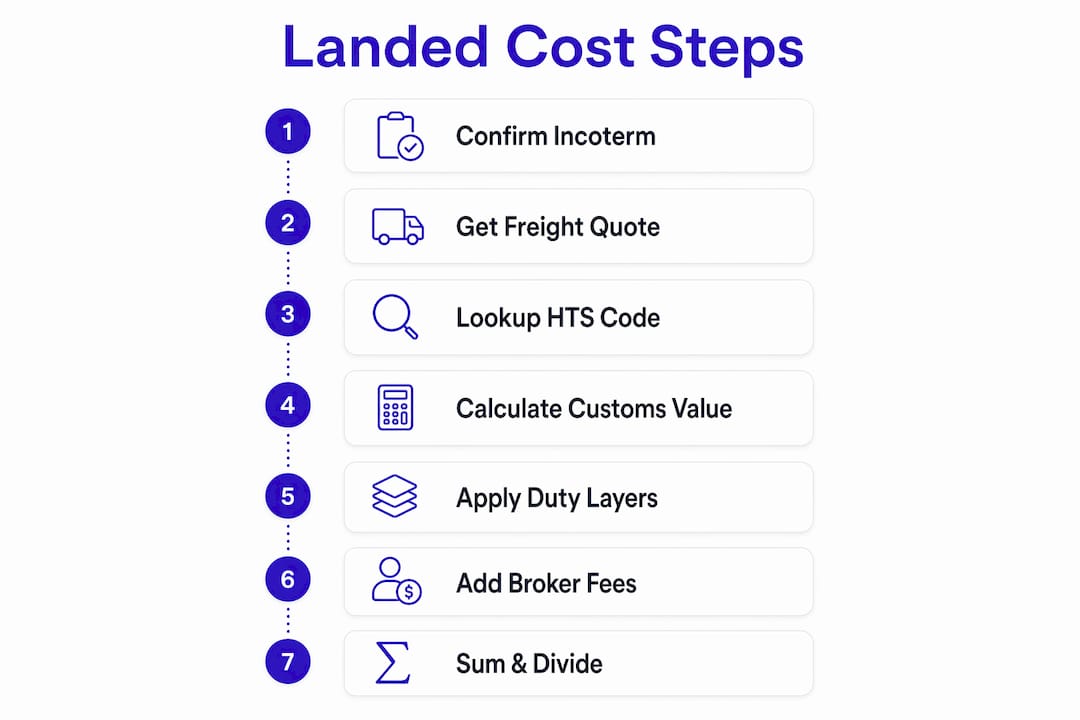
Step 1: Confirm your Incoterm. Know what’s already in the supplier price. FOB means you add freight and insurance separately. CIF means you subtract them before calculating U.S. duties.
Step 2: Get a current freight quote. Contact your freight forwarder for your specific lane, mode, and cargo dimensions. Never use rates from a guide more than a few weeks old.
Step 3: Look up your HTS code. Use the USITC Harmonized Tariff Schedule database. Identify the MFN rate and check for applicable Section 301, Section 232, or AD/CVD overlays.
Step 4: Calculate customs value. For U.S. entries, duties are assessed on the FOB value. Confirm this with your broker if your invoice is on CIF terms.
Step 5: Apply all duty layers. Add MFN plus every applicable surcharge. Calculate MPF at 0.3464% (capped at $614.35) and HMF at 0.125% for ocean shipments.
Step 6: Add broker fees, port costs, and inland delivery. Use actual quotes, not estimates. Include an ISF filing fee and a demurrage contingency for complex shipments.
Step 7: Sum all components and divide by units. That per-unit figure is your true cost basis for pricing and margin analysis.
How to keep your landed cost data accurate over time
Landed cost data goes stale fast. Freight rates shift seasonally, tariff schedules change with trade policy, and exchange rates move continuously. A cost model that was accurate in january may be badly wrong by april.
Update your landed cost data on these triggers:
- Quarterly at minimum: Refresh freight benchmarks and confirm no HTS rate changes have taken effect.
- After any tariff announcement: Section 301 and Section 232 rates have changed multiple times in recent years. Set alerts for USITC and CBP notices.
- Before each purchase order: Request a fresh freight quote. Lock the rate for the period you need it.
- When exchange rates move more than 3%–5%: Recalculate your product cost in USD if you’re paying suppliers in a foreign currency.
Treat your landed cost model as a living document, not a one-time calculation. Sellers who update it regularly make better sourcing decisions and avoid the margin surprises that come from stale data.
How currency fluctuations affect your total landed cost
Currency risk runs in two directions. If you pay your supplier in Chinese yuan or another foreign currency, a weaker dollar raises your product cost in USD terms before you’ve added a single fee. If you invoice customers in a foreign currency, a stronger dollar erodes your revenue when converted back.
For U.S. importers paying suppliers in USD, the direct currency exposure is smaller, but it still affects freight costs (often quoted in USD but influenced by fuel prices tied to global markets) and the competitiveness of foreign suppliers whose costs are denominated in local currency. A supplier in Vietnam whose costs are in dong becomes relatively cheaper when the dong weakens against the dollar, which can shift the sourcing math even when your duty rates stay constant.
The practical fix is to build a currency buffer of 2%–4% into your landed cost model for any supplier relationship denominated in a volatile currency, and to recalculate whenever the rate moves meaningfully. Locking forward contracts with your bank or payment provider can protect margin on large purchase orders with long lead times.
Key Takeaways
Accurate landed cost calculation is the foundation of every profitable import decision, requiring current tariff data, real freight quotes, and all government fees, not just the supplier invoice.
| Point | Details |
|---|---|
| Landed cost exceeds invoice price | Consumer goods from China typically land 40–50% above the FOB product price when all duties and fees are included. |
| Tariff stacking is the biggest variable | MFN, Section 301, and Section 232 duties stack; using only the base HTS rate produces a badly wrong duty figure. |
| MPF and HMF are non-negotiable | MPF is 0.3464% of declared value (capped at $614.35); HMF is 0.125% on ocean cargo with no cap. |
| Static models go stale quickly | Update freight benchmarks quarterly and recalculate after every tariff announcement or significant exchange rate move. |
| Per-unit cost drives pricing | Divide total landed cost by unit count before setting any retail or wholesale price. |
For Amazon FBA sellers managing sourcing across multiple origins, Resell-ready tracks real-time ROI, net profit, and inventory value in one dashboard, so your landed cost math feeds directly into your margin decisions without a separate spreadsheet.
Recommended
Ready to flip smarter?
ResellReady shows real sold prices, surfaces profitable deals, and builds your buying plan — the Basic plan starts with a 3-day free trial.
Get Started →