Route Every Book to Its Best-Paying Platform Fast

Route Every Book to Its Best-Paying Platform Fast
Send textbooks and high-demand catalog titles to Amazon. Send rare, collectible, and out-of-print books to eBay. Send low-value paperbacks to a buyback service or your local used bookstore. That’s the whole routing rule, and everything else is detail.
The filter underneath all of it is simple: never buy a book unless you know your minimum net profit before you hand over cash. If the math doesn’t clear that number after fees and shipping, walk away, no matter how good the deal feels.
Looking for a tool to run the numbers? ResellReady's reseller profit calculator pulls live comps across eBay, Depop, Mercari, and Poshmark and calculates true net profit after fees. Compare plans and pricing — Basic starts with a 3-day free trial.
Here’s the 30-second scan that makes the call for you:
- Scan the ISBN with the Amazon Seller app to check the Best Sellers Rank and current price.
- Check BookScouter for instant buyback offers if the book looks low-value or you want fast cash.
- Pull eBay sold listings if the book looks rare, signed, or collectible.
- Do the math on fees and shipping before you decide, not after.
Key Takeaways
Profitable book reselling comes down to routing each title to the platform that pays best for its type, then refusing to buy anything that misses your net profit threshold.
| Point | Details |
|---|---|
| Route by book type | Send textbooks and catalog titles to Amazon; send rare or collectible books to eBay. |
| Scan before you buy | Check BSR on the Amazon Seller app and BookScouter buyback offers before spending cash. |
| Run the fee math first | Referral fees, FBA costs, and real shipping expenses can erase most of a low-margin buy. |
| Match fulfillment to velocity | Use FBA for fast-moving textbooks; use FBM for slow or oversized inventory. |
| Scale with real tracking | Resell-ready gives instant ASIN and ISBN insights plus automated profit tracking once spreadsheets stop keeping up. |
Table of Contents
- How Book Reselling on eBay and Amazon Actually Differs
- Where to Find Profitable Books and How to Scan Them in a Minute
- What Fees and Shipping Actually Cost You Per Book
- Listing Details That Actually Move Books Faster
- Choosing FBA or FBM for Each Book You List
- Scaling Past a Side Hustle Without Losing Your Margins
- The Mistakes That Quietly Kill Your Margin
- Why I Stopped Trusting My Memory for Pricing
- Scale Your Book Flipping With a Real Profit Terminal
- Sources
How Book Reselling on eBay and Amazon Actually Differs
Amazon runs on a shared catalog. Every copy of the same ISBN lands on one product page, and you’re competing for the Buy Box on price, condition rating, and fulfillment speed. That structure rewards volume and standardization. It’s brutal for anything unusual, because a rare first edition gets flattened into the same listing as a beat-up reading copy.
eBay works the opposite way. You build an individual listing with your own photos, your own title, and your own condition notes, which is exactly why eBay suits rare, collectible, and out-of-print books so well. Buyers there are often collectors hunting a specific edition, not students grabbing the cheapest copy of a required text.
Fees and buyer psychology diverge just as much. Amazon’s Prime eligibility through FBA drives conversion on commodity titles; eBay’s auction format can spike prices on genuinely scarce items when two collectors start bidding against each other.
Practical routing:
- Textbooks, cookbooks, popular fiction → Amazon.
- Signed copies, first editions, out-of-print titles → eBay.
- Water-damaged, outdated, or low-BSR paperbacks → buyback or donate.
Where to Find Profitable Books and How to Scan Them in a Minute
Library book sales, thrift stores, estate sales, and campus dorm clear-outs at semester end consistently produce the highest-yield sourcing hauls for resellers. Estate sales in particular tend to surface older editions and complete series that never show up in a typical thrift bin.
Once you’re standing in front of a box of books, run this sequence:
- Scan the ISBN in the Amazon Seller app and check the BSR. Anything under a moderate Best Sellers Rank in a relevant category usually sells within weeks.
- Cross-check BookScouter for a buyback quote if you’re unsure the book is worth listing yourself.
- Pull eBay sold listings (not active listings) if it looks like a collectible.
- Walk away if the acquisition cost plus estimated fees eats more than half your projected sale price.
Red flags worth skipping every time: torn covers, water stains, missing dust jackets on collector editions, and any book with a BSR over a few million.
Pro Tip: Buy the whole box at a flat rate when a seller offers it. You’ll eat a few duds, but the per-book cost usually drops low enough that even mediocre titles clear your profit threshold.
What Fees and Shipping Actually Cost You Per Book
Amazon takes a referral fee of roughly 15% on most books, plus either FBA fulfillment and storage costs or your own packaging and postage under FBM. eBay charges a final value fee on the total sale price including shipping, and your actual carrier cost eats into whatever shipping credit the buyer paid.
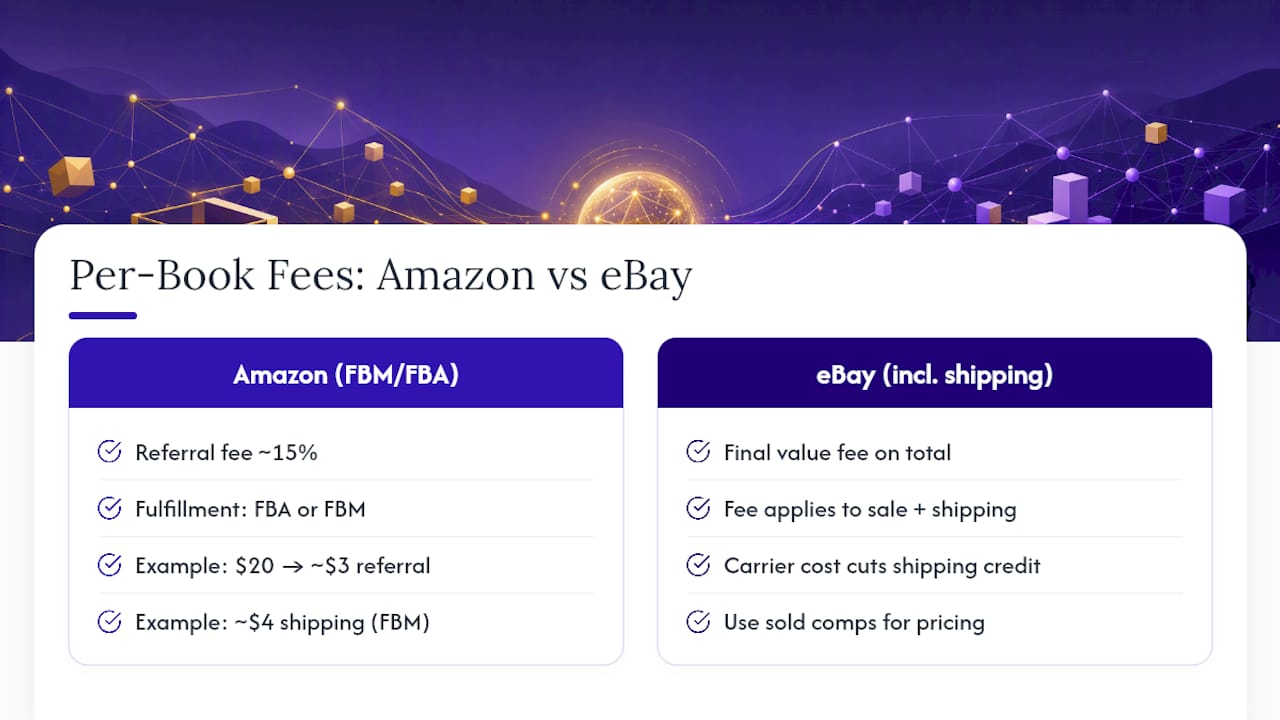
Here’s the math on a $20 hardcover sold on Amazon FBM: $20 sale, minus roughly $3 referral fee, minus $4 in actual shipping and packaging, leaves about $13 before your acquisition cost. Buy that book for $2 at an estate sale and you’ve cleared $11. Buy it for $12 at an overpriced thrift store and you’ve barely cleared a dollar, which isn’t worth the shelf space.
Set a hard per-unit minimum before you shop, not after you’ve already bought the box. Experienced high-volume sellers stick to that threshold specifically because thin-margin books tie up capital and shelf space that could go toward better inventory.
A quick math check: Amazon’s referral fee runs around 15% on most book categories, and that’s before FBA or shipping costs even enter the equation.
Use BSR for Amazon sell-through speed and actual eBay sold comps, not active listings, to set realistic pricing.
Listing Details That Actually Move Books Faster
Photograph the front cover, spine, back cover, and any flaw. That’s four shots minimum, all in natural light against a plain background. Clear photos and honest condition notes cut down return rates dramatically, especially on eBay where buyers can’t inspect the book in person.
Grade condition honestly: note highlighting, water stains, cracked spines, or missing dust jackets specifically rather than writing a vague “good” rating. Vague grading is the fastest way to earn a return.
- Amazon titles: title and details are locked to the catalog page, so your differentiators are photos, price, and condition rating.
- eBay titles: write a specific title with edition, printing, and condition (“1st edition, 1987, dust jacket intact”) since buyers search by those exact terms.
- Auction vs fixed price on eBay: use auctions for genuinely scarce items where competitive bidding can push price up; use fixed price for anything with predictable comps.
- FBM pricing on Amazon: price a few cents below the lowest FBA offer if you’re shipping yourself, since buyers expect a discount for slower delivery.
Pro Tip: Check eBay’s real sold prices, not the asking prices on active listings, before you set your own. Active listings show what sellers hope for; solds show what buyers actually paid.
Choosing FBA or FBM for Each Book You List
The rule of thumb: textbooks and fast-moving titles justify FBA because Prime eligibility and Amazon’s fulfillment speed drive conversion on books people need quickly, especially around semester starts. Slow-moving or oddly-sized books usually don’t.
- Check velocity first. If BSR suggests it’ll sell within 30 to 60 days, FBA’s storage fee is a rounding error against the conversion boost.
- Check size and weight. Oversized art books and boxed sets often trigger higher FBA fees that erase your margin advantage.
- Check your prep capacity. FBA requires labeling, poly-bagging in some categories, and shipment scheduling; if you’re not batching yet, FBM buys you flexibility.
- Check for long-tail risk. A rare book that might sit for six months is a bad FBA candidate. Long-term storage fees will quietly erode any profit you thought you locked in.
Scaling Past a Side Hustle Without Losing Your Margins
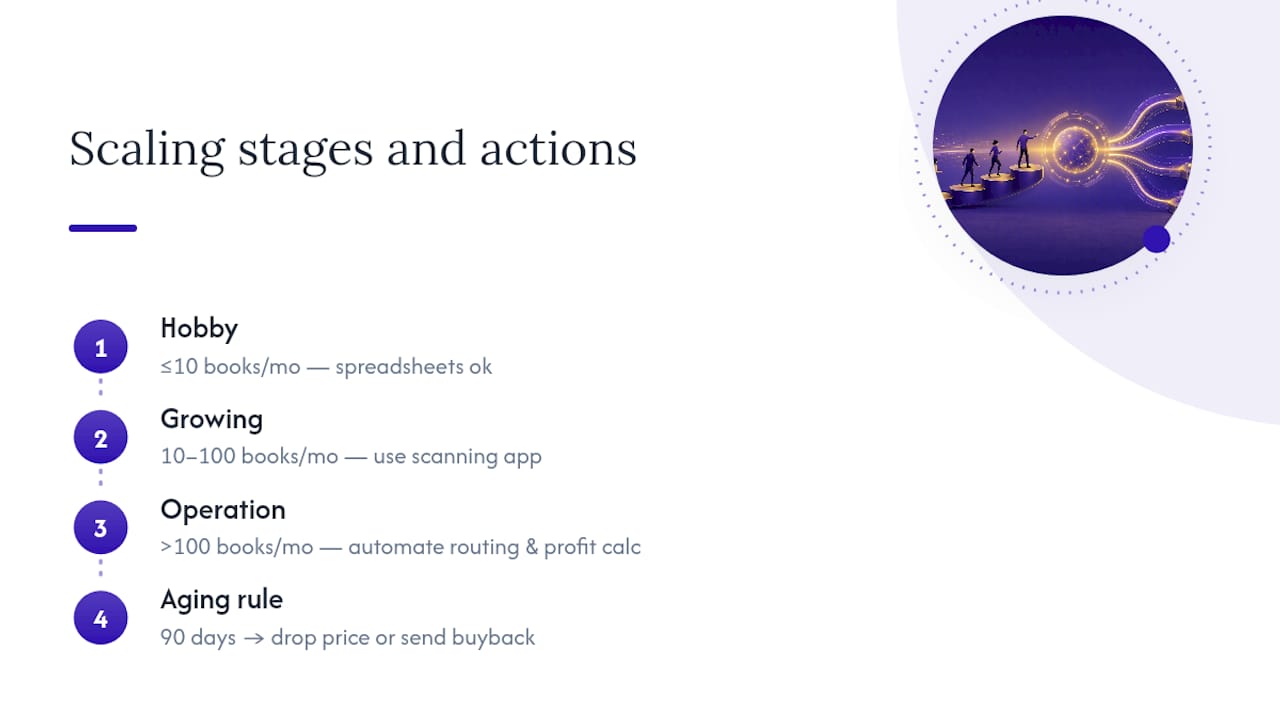
Batching is what separates a hobby from an operation. Standardize your photo setup, use the same listing templates, and ship on a schedule instead of running to the post office after every sale. Set an aging rule, too. If a book hasn’t sold in 90 days, drop the price or route it to buyback before storage costs quietly eat your margin.
Spreadsheets work fine at ten books a month. They break down at a hundred. That’s when a scanning app paired with a real profit calculator earns its cost. Resell-ready gives you instant ASIN and ISBN insights, automated inventory dashboards, watchlists for price targets, and a verified supplier database, which matters once you’re sourcing lots instead of individual titles.
Pro Tip: The moment you’re manually recalculating fees on more than a handful of books a week, you’ve already outgrown the spreadsheet.
The Mistakes That Quietly Kill Your Margin
Most losses trace back to four habits: skipping the full shipping math, misgrading condition, buying low-value paperbacks because they were cheap rather than because they’re profitable, and holding onto slow inventory that racks up storage fees while doing nothing.
Cash flow risk shows up when too much capital sits in unsold books. Set a hard cutoff, retire anything that’s aged past your threshold, and route it to buyback rather than let it sit.
Three rules worth adopting immediately:
- Never buy without running the fee and shipping math first, not after you’ve already paid.
- Grade condition conservatively, since an unhappy buyer costs more in returns and seller metrics than a lower listing price would have.
- Cap how long any single title can sit before you discount or liquidate it.
Handle returns fast on both platforms. A quick refund protects your seller rating far more than fighting a dispute over a $12 paperback ever will.
Why I Stopped Trusting My Memory for Pricing
Early on, I priced books off gut feeling and lost margin on things I should have flipped instantly. Once sourcing volume went up, disciplined scanning and real profit tracking stopped being optional. A tool that shows net profit before you buy, not after, changes how confidently you scale.
— Christian
Scale Your Book Flipping With a Real Profit Terminal
Once you’re moving past a shoebox of books a month, guesswork gets expensive fast. Resell-ready replaces the spreadsheet with a single dashboard built for resellers who need answers in seconds, not after a lunch break spent recalculating fees.
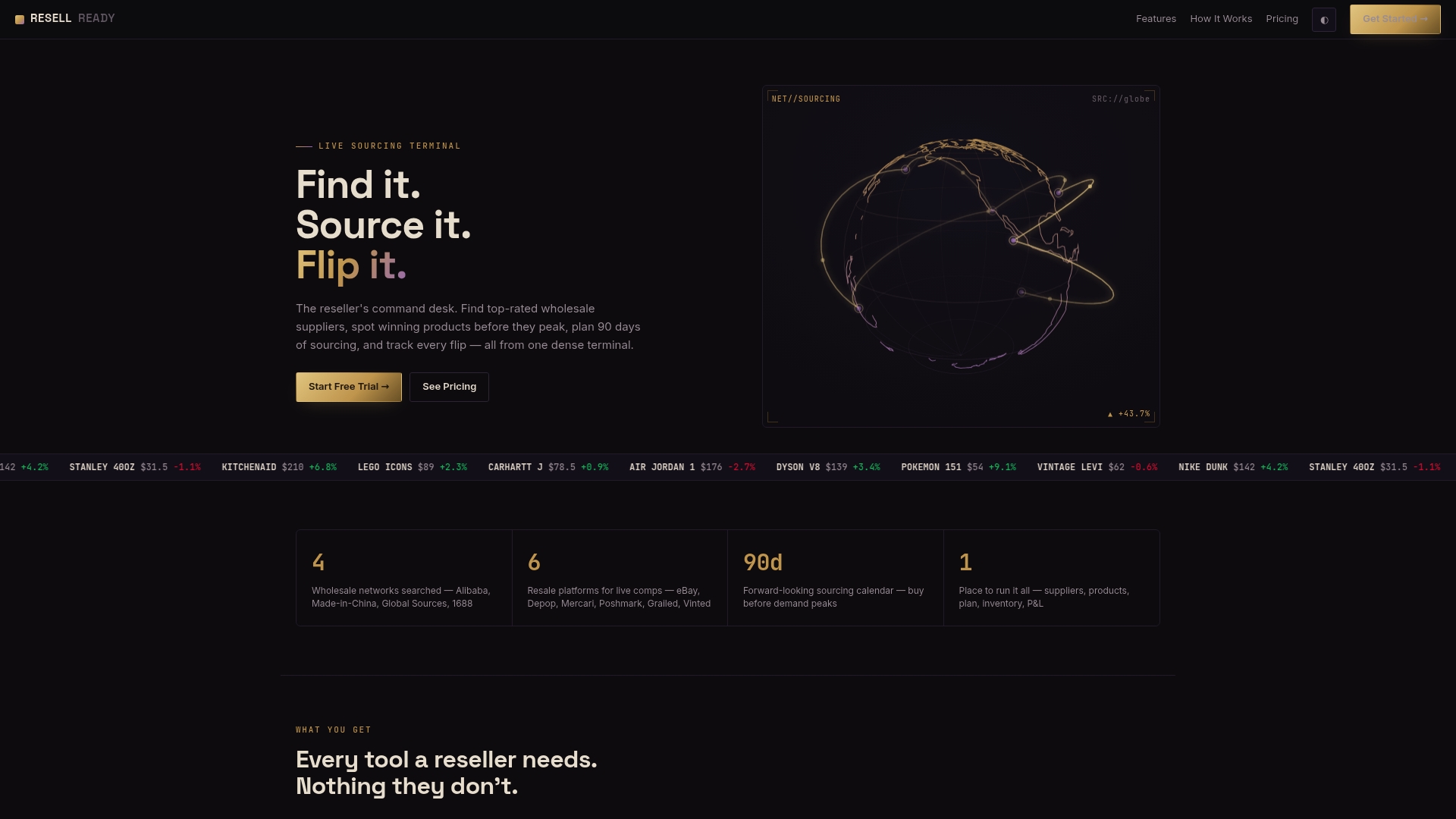
Paste an ASIN or ISBN and get instant net profit and ROI numbers before you commit cash. The automated inventory dashboard tracks what you’ve bought, what’s aging, and what’s actually earning. Watchlists alert you when a price target hits, and the verified supplier database helps you source lots without guessing whether a deal is real.
This fits resellers scaling from occasional thrift runs into a genuine multi-channel operation across Amazon, eBay, and beyond with the best guidance on marketplace alternatives from brickInsiders. If you’re ready to stop rebuilding the same formulas every week, check the sneaker and book reselling ROI tracker and see what your current inventory would look like with real profit numbers attached.
Sources
- Selling textbooks: A guide for resellers - Sell on Amazon
- Where to sell used books for the best price in 2026 (Chapter.pub blog)
- eBay vs Amazon for Resellers: Which Platform Is Right for Your Business in 2026 | Listofer | Listofer
- Where to Sell Used Books for the Best Price in 2026
Recommended
Ready to flip smarter?
ResellReady shows real sold prices, surfaces profitable deals, and builds your buying plan — the Basic plan starts with a 3-day free trial.
Get Started →