AI Product Sourcing for Amazon FBA Resellers: 2026 Guide

AI Product Sourcing for Amazon FBA Resellers: 2026 Guide
AI product sourcing is an automated, constraint-driven workflow that finds, verifies, and models wholesale suppliers and landed cost to produce buy/skip signals for Amazon FBA sellers. If you are running a professional FBA operation right now, the single best next step is to upload your past purchase orders into a constraint-aware sourcing tool, run a supplier discovery pass, and use the resulting landed-cost estimates to filter your shortlist before you send a single RFQ.
Two capabilities are non-negotiable: a verified supplier database and landed-cost modeling that accounts for duties, freight, and port fees. Without both, you are making margin decisions on incomplete data.
Table of Contents
- What does AI product sourcing actually mean for FBA resellers?
- What core capabilities does every AI sourcing tool need?
- What are the biggest risks of AI sourcing, and how do you contain them?
- How do you run a full AI sourcing workflow across 90 days?
- Which KPIs tell you whether AI sourcing is helping or hurting your margins?
- What does a realistic AI sourcing timeline and budget look like?
- How do you evaluate an AI sourcing platform before you buy?
- Why does Resell-ready map to professional FBA sourcing requirements?
- Key Takeaways
- The gap between AI sourcing hype and what actually protects your margins
- Resell-ready: what to test in your first 7 days
- Sources and further reading
What does AI product sourcing actually mean for FBA resellers?
Automated product sourcing, in the FBA context, is not a chatbot that suggests trending products. It is a structured pipeline: the system ingests your constraints, scans supplier databases, normalizes quotes, and returns a ranked shortlist with a buy/skip signal attached.
Minimum inputs the system needs from you:
- Past purchase orders, product specs, and target sell price
- Target ROI floor and acceptable MOQ range
- Marketplace price sources (Amazon ASIN data, eBay, Mercari, Poshmark, Depop, Grailed, Vinted)
What you get back:
- A ranked supplier shortlist with normalized quote fields (unit price, MOQ, lead time, incoterms)
- An estimated landed cost per unit (duties, freight, port fees included)
- A suggested buy/skip verdict based on your margin floor
- A quote comparison table ready for export
Constraint modeling converts unstructured inputs like emails and past POs into structured sourcing rules, which is what makes the landed-cost output reliable enough to act on.
What core capabilities does every AI sourcing tool need?
Not every platform marketed as an intelligent sourcing solution actually delivers the features that move the needle for professional resellers. Here is what to require before you commit.

| Capability | What it does | Why it matters for FBA |
|---|---|---|
| Constraint modeling | Converts POs and emails into hard sourcing filters | Matches suppliers to your actual MOQ, lead time, and margin floor |
| Landed-cost modeling | Calculates duties, freight, HS codes, and port fees | Prevents margin surprises at the border |
| Verified supplier database | Cross-references trade data and on-site checks | Reduces fraud and spec-drift risk |
| RFQ normalization | Parses email and WhatsApp replies into structured fields | Enables apples-to-apples quote comparison |
| Live marketplace price checks | Pulls real-time prices from eBay, Depop, Mercari, Poshmark, Grailed, Vinted | Grounds your sell-price assumption in current market data |
| 90-day sourcing calendar and watchlist | Tracks milestones and triggers alerts on price targets | Keeps the pipeline moving without manual follow-up |
| CSV export and audit trail | Exports normalized data for external review | Supports team collaboration and PO documentation |
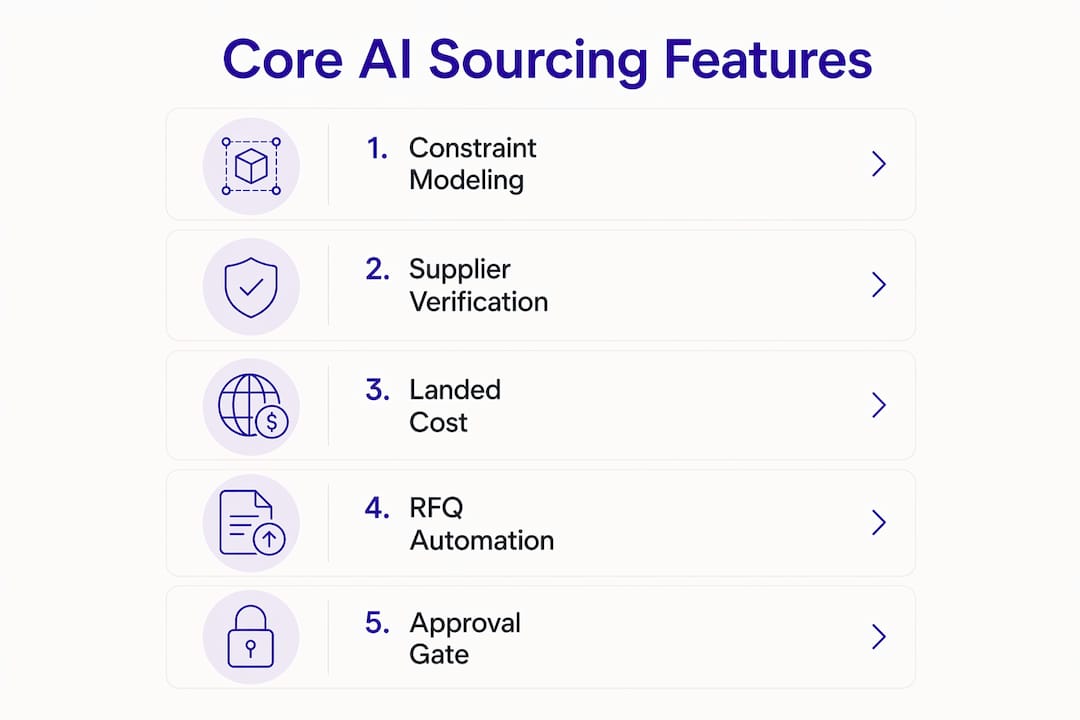
RFQ automation that parses supplier replies from multiple channels and extracts price, MOQ, lead time, and incoterms into a single comparison view is the feature most teams underestimate until they are manually copying numbers from twenty email threads.
What are the biggest risks of AI sourcing, and how do you contain them?
The failure mode most teams hit is not a bad algorithm. It is trusting AI-extracted data without a human verification step.
Primary risks:
- Unverified supplier data leading to spec drift between sample and production run
- Commission-driven recommendations from platforms that earn fees from the suppliers they rank
- Incorrect landed-cost estimates from missing or misclassified HS codes
- Approval gate failures where AI-drafted outreach goes out unreviewed and damages supplier relationships
Mitigations:
- Require a human verification gate before any supplier outreach is sent; AI agents plus expert teams that handle on-site verification and spec confirmation reduce sourcing risk materially
- Use independent, non-marketplace platforms that do not earn commissions from suppliers, so the ranking reflects your criteria, not their revenue model
- Run a sample-first policy on every new supplier before committing to a bulk order
- Conduct automated due diligence that checks trade records and risk grading before you move a supplier to active status
Pro Tip: Set your approval gate so AI drafts all outgoing supplier messages, but a human reviews and approves each one before it sends. This preserves negotiation tone and keeps relationships professional, especially with Chinese suppliers on 1688 and Alibaba where relationship context matters.
How do you run a full AI sourcing workflow across 90 days?
This sequence works for a single new SKU. Run it in parallel for multiple SKUs once the process is familiar.
- Write a product brief — target sell price, acceptable MOQ, lead-time ceiling, and margin floor
- Upload constraints — past POs, product specs, and price history so the model learns your tolerance ranges
- Run AI discovery — scan Alibaba, Global Sources, 1688, and Made-in-China simultaneously for qualified suppliers
- Send normalized RFQs — AI drafts outreach; human approves before sending
- Parse and normalize replies — extract price, MOQ, lead time, incoterms, and HS code into a standard CSV schema
- Calculate landed cost — add duties, freight, and port fees; filter out suppliers below your ROI floor
- Order samples — one to three suppliers maximum; document spec requirements in writing
- Human verification — on-site or third-party inspection of sample against spec sheet
- Negotiate — use the normalized quote table as leverage; re-quote at target volume
- Place first PO — include production monitoring checkpoints at 30% and 70% completion
- Monitor and re-quote — set watchlist alerts; run automated re-quoting every 90 days to maintain leverage
90-day calendar milestones:
- Weeks 1–2: Discovery, RFQ send, initial reply normalization
- Weeks 3–4: Sample orders placed, verification scheduled
- Weeks 5–7: Sample review, spec confirmation, negotiation
- Weeks 8–10: First bulk PO placed, production monitoring active
- Weeks 11–12: Contingency supplier onboarded, backup quotes filed
Normalizing multi-platform supplier data from 1688, Alibaba, and Global Sources into a single structured format is what makes the week 3–4 comparison step fast enough to actually hit that calendar.
Which KPIs tell you whether AI sourcing is helping or hurting your margins?
Track these on every PO. If any metric drifts past its threshold, investigate before the next order.
- Landed cost per unit = (unit price × quantity + freight + duties + port fees) ÷ quantity. Flag if it drifts more than 5% from the estimate.
- Net profit per unit = sell price minus landed cost minus Amazon fees minus returns reserve
- ROI % = (net profit per unit ÷ landed cost per unit) × 100. Your floor is your floor; do not negotiate yourself below it.
- Gross margin % = (sell price minus landed cost) ÷ sell price × 100
- Sell-through rate = units sold ÷ units received × 100, measured at 30, 60, and 90 days
- Lead-time variance = actual lead time minus quoted lead time. A variance greater than 2× quoted is a supplier reliability flag.
- Supplier quote variance = spread between highest and lowest normalized quote for the same SKU. A wide spread signals incomplete constraint modeling.
What does a realistic AI sourcing timeline and budget look like?
Typical timelines:
- Discovery to shortlist: 1–7 days depending on database coverage and constraint complexity
- RFQ normalization: 3–10 days depending on supplier response rates
- Sampling: 14–45 days (air freight on the low end, sea freight on the high end)
- First bulk order: 30–90+ days from PO to warehouse, depending on production queue and freight mode
Cost buckets to budget:
- Platform subscription or tooling fee
- Sample costs (unit cost plus air freight, typically $50–$300 per supplier sampled)
- Inspection or audit fees if using a third-party verification service
- Duty and tariff testing on new HS code classifications
- Contingency buffer of 10–15% on landed cost for first-time suppliers
MOQ realities vary sharply by category. Many Chinese factories on 1688 will sample at low quantities, but bulk MOQs of 200–500 units are common for private-label goods. Build that into your cash-flow model before the sample stage, not after.
How do you evaluate an AI sourcing platform before you buy?
Run through this checklist on every vendor call.
Hard yes/no questions:
- Does the platform maintain an independent supplier database with no commission relationship to listed suppliers?
- Does it model landed cost including HS code lookup, duties, and freight?
- Does it support constraint modeling from uploaded POs or specs?
- Can you export a full normalized quote table as CSV?
- Is there an approval gate for outgoing supplier messages?
- Does it offer or integrate with inspection and verification services?
Red flags to walk away from:
- Opaque supplier incentives or undisclosed referral fees
- No human verification option or on-site inspection pathway
- No CSV export or watchlist functionality
- Landed-cost estimates that exclude duties or HS code classification
- No audit trail for supplier communications
Why does Resell-ready map to professional FBA sourcing requirements?
Resell-ready is built specifically for professional Amazon FBA resellers, and its feature set covers the checklist above directly.
| Requirement | Resell-ready feature |
|---|---|
| Verified supplier database | Verified supplier directory with no commission model |
| Live marketplace price checks | Real-time pricing across eBay, Depop, Mercari, Poshmark, Grailed, and Vinted |
| ASIN insights | Instant ASIN lookup for Amazon sell-price validation |
| Landed cost and ROI tracking | Automated P&L with real-time net profit per unit |
| 90-day sourcing calendar | Built-in calendar with milestone tracking |
| Watchlist alerts | Price-target alerts for active SKUs |
| CSV export | Bulk export for quote comparison and team review |
| Supplier search coverage | Alibaba, Global Sources, 1688, and Made-in-China in one interface |
The 7-day pilot approach: upload two or three past POs on day one, run a supplier discovery pass, compare the normalized quotes against your current supplier’s pricing, and check the landed-cost estimate against your last actual invoice. That gap, if there is one, is your immediate savings opportunity.
Key Takeaways
AI product sourcing works when constraint modeling, verified supplier data, and landed-cost accuracy work together — without all three, the buy/skip signal is unreliable.
| Point | Details |
|---|---|
| Upload past POs first | Constraint modeling trained on real POs produces far more relevant supplier matches than generic searches. |
| Require verified supplier data | Unverified databases are the leading cause of spec drift between sample and production. |
| Sample before every bulk order | A sample-first policy catches quality failures before they become a full-inventory write-off. |
| Track landed cost variance | Flag any drift greater than 5% from the estimate before placing the next PO. |
| Resell-ready covers the checklist | Verified supplier directory, live marketplace price checks, ASIN insights, 90-day calendar, and CSV export in one platform. |
The gap between AI sourcing hype and what actually protects your margins
Most articles about intelligent sourcing solutions spend their energy on discovery speed. Find 100 suppliers in seconds. That part is real, and it matters. But the sourcing failures that actually cost professional FBA resellers money almost never happen at the discovery stage. They happen at verification, at landed-cost estimation, and at the sample-to-production handoff.
The approval gate concept deserves more attention than it gets. Letting AI draft supplier outreach is genuinely useful. Letting it send that outreach without review is where teams damage relationships they spent months building. Tone, timing, and negotiation context are still human work. The AI handles the volume; you handle the judgment calls.
The other underrated risk is commission-driven ranking. A platform that earns fees from the suppliers it recommends has a structural conflict with your margin goals. That conflict does not disappear because the interface looks sophisticated. Independent tools that do not take supplier commissions are not a nice-to-have feature. They are the baseline for unbiased recommendations.
Resell-ready: what to test in your first 7 days
Professional FBA teams spend hours cross-referencing supplier quotes, checking live resale prices, and manually updating P&L spreadsheets. Resell-ready replaces that stack with a single terminal built for speed: paste an ASIN for instant margin data, search verified suppliers across Alibaba, Global Sources, 1688, and Made-in-China, and pull live resale prices from eBay, Depop, Mercari, Poshmark, Grailed, and Vinted in the same session.
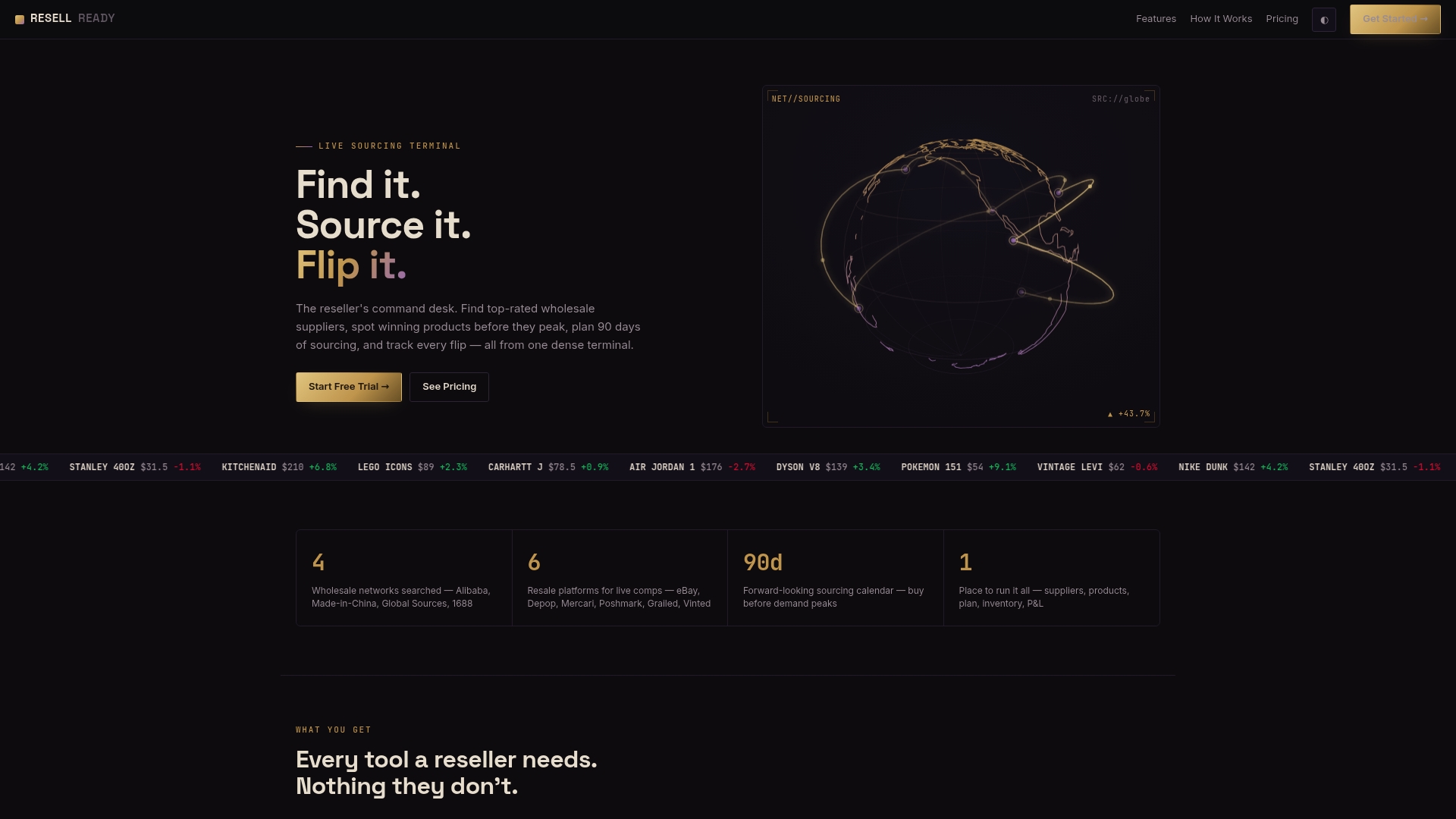
The free trial gives you enough access to run a real pilot. On day one, run a supplier discovery search on a current SKU and compare the results against your existing supplier’s pricing. By day three, check the 90-day sourcing calendar and set a watchlist alert on a product you are monitoring. By day seven, export a CSV of your normalized quotes and run the ROI filter. If the numbers look different from what your spreadsheet shows, that difference is the point.
Paid tiers unlock unlimited supplier searches, bulk price-check tools, advanced profit reporting, and higher watchlist limits. Start the trial at resell-ready.com and run the 7-day pilot against your current sourcing process.
Sources and further reading
- Resell-ready platform features and trial — verified supplier directory, ASIN insights, ROI tracking, 90-day calendar
- FlexSource — constraint modeling from POs and specs, landed-cost modeling, multi-country supplier discovery
- SourcingGPT — RFQ automation, quote normalization, HS code and landed-cost calculation
- SourcingX — automated due diligence, trade record aggregation, risk grading
- Workus — AI agents with expert on-site verification and inspection support
- Sorsa — independent procurement outreach with no supplier commission model
Recommended
Ready to flip smarter?
ResellReady shows real sold prices, surfaces profitable deals, and builds your buying plan — the Basic plan starts with a 3-day free trial.
Get Started →